Ace - AI Tutor
Ask Our Educators
Textbooks
My Library
Flashcards
Scribe - AI Notes
Notes & Exams
Download App
Goat  Diaz

Goat D.

Divider

Books Assigned

Fundamentals of Physics

Fundamentals of Physics

David Halliday,… 11th Edition
Achievement 1,083 solutions
Fundamentals of Physics

Fundamentals of Physics

David Halliday,… 9th Edition
Achievement 1,317 solutions
Advanced Engineering Mathematics

Advanced Engineering Mathematics

Dennis G. Zill,… 5th Edition
Achievement 1,253 solutions

Viewed Questions

A fuse in an electric circuit is a wire that is designed to melt, and thereby open the circuit, if the current exceeds a predetermined value. Suppose that the material to be used in a fuse melts when the current density rises to $440 \mathrm{~A} / \mathrm{cm}^{2} .$ What diameter of cylindrical wire should be used to make a fuse that will limit the current to $0.50 \mathrm{~A}$ ?

Fundamentals of Physics

A fuse in an electric circuit is a wire that is designed to melt, and thereby open the circuit, if the current exceeds a predetermined value. Suppose that the material to be used in a fuse melts when the current density rises to $440 \mathrm{~A} / \mathrm{cm}^{2}$. What diameter of cylindrical wire should be used to make a fuse that will limit the current to $0.50 \mathrm{~A} ?$

Fundamentals of Physics

Reproduce the given computer-generated direction field. Then sketch, by hand, an approximate solution curve that passes through each of the indicated points. Use different colored pencils for each solution curve. $$ \frac{d y}{d x}=e^{-0.01 x y^{2}} $$ (a) $y(-6)=0$ (b) $y(0)=1$ (c) $y(0)=-4$ (d) $y(8)=-4$

Advanced Engineering Mathematics

First-Order Differential Equations

Solution Curves Without a Solution

Use partial fractions to evaluate the given integral.
$$
\int \frac{x-1}{x\left(x^{2}+1\right)} d x
$$

Use partial fractions to evaluate the given integral. $$ \int \frac{x-1}{x\left(x^{2}+1\right)} d x $$

Calculus, Early Transcendentals

Techniques of Integration

Partial Fractions

Questions asked

ANSWERED

Tavis Lam verified

Numerade educator

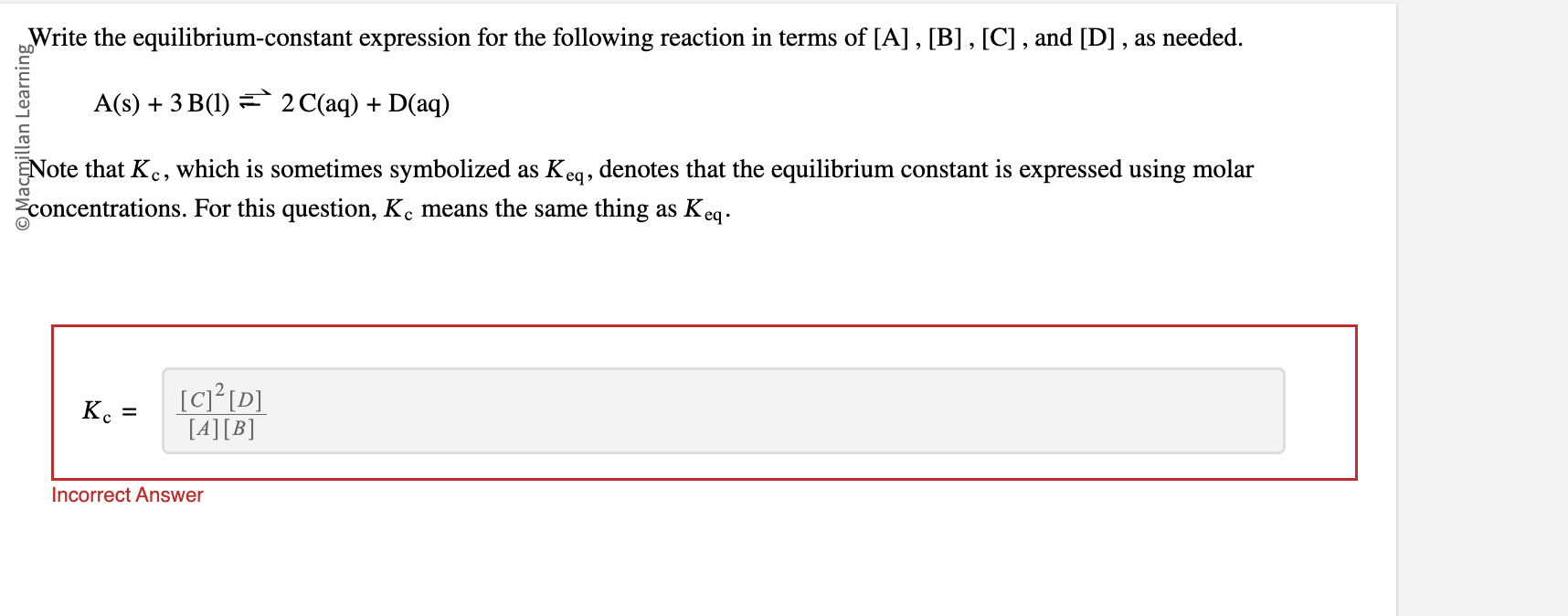
Write the equilibrium-constant expression for the following reaction in terms of [A] , [B] , [C] , and [D] , as needed. A(s) + 3 B(l) ? 2 C(aq) + D(aq) Note that Kc , which is sometimes symbolized as Keq , denotes that the equilibrium constant is expressed using molar concentrations. For this question, Kc means the same thing as Keq. Kc = ([C]^2[D])/([A][B])
View Answer
divider
ANSWERED

Ivan Kochetkov verified

Numerade educator

Write the equilibrium-constant expression for the following reaction in terms of [A] , [B] , [C] , and [D] , as needed. A(s) + 3 B(l) ? 2 C(aq) + D(aq) Note that Kc , which is sometimes symbolized as Keq , denotes that the equilibrium constant is expressed using molar concentrations. For this question, Kc means the same thing as Keq. Kc = [C]²[D] / [A][B]

View Answer
divider
ANSWERED

Ivan Kochetkov verified

Numerade educator

Write the equilibrium-constant expression for the reaction shown in terms of [A], [B], [C], and [D]. A(g) + B(g) ? 2 C(g) + D(g) Note that Kc, which is sometimes symbolized as K or Keq, denotes that the equilibrium constant is expressed using molar concentrations. For this question, Kc means the same thing as K and Keq. Kc = ([C]^2 [D]^2) / ([A]^3 [B])

View Answer
divider
ANSWERED

Nishant Kumar verified

Numerade educator

Required information NOTE: This is a multi-part question. Once an answer is submitted, you will be unable to return to this part. A 48-in. boom is held by a ball-and-socket joint at C and by two cables BF and DAE; cable DAE passes around a frictionless pulley at A. For W = 470 lb , determine the tension in each cable and the reaction at C. (Include a minus sign if necessary.) The tension in cable DAE is 715 lb. The tension in cable BF is 835 lb. The reaction at C is ( -165 lb) i + ( 165 lb) j + ( 2145 lb) k.

View Answer
divider
ANSWERED

Supratim Pal verified

Numerade educator

Required information NOTE: This is a multi-part question. Once an answer is submitted, you will be unable to return to this part. A rod ( A B ) is hinged at ( A ) and attached at ( B ) to cable ( B D ) that supports the loads as shown in the figure. Given: ( d=200 mathrm{~mm} ), ( X=85 mathrm{~N} ), and ( Y=85 mathrm{~N} ). Determine the tension in cable ( B D ). The tension in cable ( B D ) is ( square ) N.

View Answer
divider
ANSWERED

Supratim Pal verified

Numerade educator

Required information NOTE: This is a multi-part question. Once an answer is submitted, you will be unable to return to this part. A rod ( A B ) is hinged at ( A ) and attached at ( B ) to cable ( B D ) that supports the loads as shown in the figure. Given: ( d=200 mathrm{~mm} ), ( X=85 mathrm{~N} ), and ( Y=85 mathrm{~N} ). Determine the tension in cable ( B D ). The tension in cable ( B D ) is ( square ) N.

View Answer
divider
ANSWERED

Shalini Tyagi verified

Numerade educator

Required information NOTE: This is a multi-part question. Once an answer is submitted, you will be unable to return to this part. A rod ( A B ) is hinged at ( A ) and attached at ( B ) to cable ( B D ) that supports the loads as shown in the figure. Given: ( d=200 mathrm{~mm} ), ( X=85 mathrm{~N} ), and ( Y=85 mathrm{~N} ). Determine the tension in cable ( B D ). The tension in cable ( B D ) is ( square ) N.

View Answer
divider
ANSWERED

Supratim Pal verified

Numerade educator

NOTE: This is a multi-part question. Once an answer is submitted, you will be unable to return to this part. Consider the given plate and loading shown in figures (a) and (b). Determine the reactions at A and B. Given : X = 51 lb and Y = 50 lb . The magnitude of reaction force at A is 14.5 lb at 15.87 degrees. The magnitude of reaction force at B is 62.13 lb at 34.84 degrees.

View Answer
divider
ANSWERED

Tavis Lam verified

Numerade educator

Required information NOTE: This is a multi-part question. Once an answer is submitted, you will be unable to return to this part. Consider the given plate and loading shown in figures (a) and (b). Determine the reactions at A and B. Given : X = 40 lb and Y = 75 lb . The magnitude of reaction at A is [ ] lb (Click to select) . The magnitude of reaction at B is [ ] lb ? [ ] °.

View Answer
divider
ANSWERED

Tavis Lam verified

Numerade educator

Required information NOTE: This is a multi-part question. Once an answer is submitted, you will be unable to return to this part. Consider the given plate and loading shown in figures (a) and (b). Determine the reactions at A and B. Given : X = 51 lb and Y = 50 lb . The magnitude of reaction force at A is [ ] lb ? [ ] °. The magnitude of reaction force at B is [ ] lb ? [ ] °.

View Answer
divider