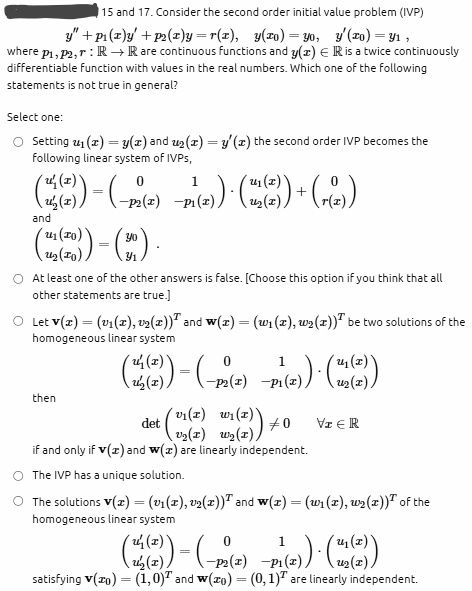
Consider the second-order initial value problem (IVP)
y'' + p1(x)y' + p2(x)y = r(x), y(x0) = y0, y'(x0) = y1,
where p1, p2, r: R -> R are continuous functions and y(x) in R is a twice continuously differentiable function with values in the real numbers. Which one of the following statements is not true in general?
Select one:
Setting u1(x) = y(x) and u2(x) = y'(x) the second-order IVP becomes the following linear system of IVPs,
([u1'(x)], [u2'(x)]) = ([0, 1], [-p2(x), -p1(x)]) * ([u1(x)], [u2(x)]) + ([0], [r(x)])
and
([u1(x0)], [u2(x0)]) = ([y0], [y1]).
At least one of the other answers is false. [Choose this option if you think that all other statements are true.]
Let v(x) = (v1(x), v2(x))^T and w(x) = (w1(x), w2(x))^T be two solutions of the homogeneous linear system
([u1'(x)], [u2'(x)]) = ([0, 1], [-p2(x), -p1(x)]) * ([u1(x)], [u2(x)])
then
det([v1(x), w1(x)], [v2(x), w2(x)]) != 0, AA x in R
if and only if v(x) and w(x) are linearly independent.
The IVP has a unique solution.
The solutions v(x) = (v1(x), v2(x))^T and w(x) = (w1(x), w2(x))^T of the homogeneous linear system
([u1'(x)], [u2'(x)]) = ([0, 1], [-p2(x), -p1(x)]) * ([u1(x)], [u2(x)])
satisfying v(x0) = (1, 0)^T and w(x0) = (0, 1)^T are linearly independent.
15 and 17. Consider the second-order initial value problem (IVP) y + pixy' + pxy = rxyxo = 30yxo = y1
where p1, p2, : IR -> IR are continuous functions and y() in IR is a twice continuously differentiable function with values in the real numbers. Which one of the following statements is not true in general?
Select one:
Setting = (and = the second-order IVP becomes the following linear system of IVPs,
x ux) and
0 2x - p1(x
O At least one of the other answers is false. [Choose this option if you think that all other statements are true.]
OLetv = v1xv2x and w(x = w1xw2x be two solutions of the homogeneous linear system
x x
p2(x - p1x
U(x)
then
v1xw1x det 0 v2xw2x
VR
if and only if v() and w() are linearly independent.
O The IVP has a unique solution.
The solutions v = v and w = w of the homogeneous linear system
x ux
0
x 2x
p2x - p1x
satisfying vo) = 1, 0 and wo = 0, 1 are linearly independent.