You should now understand how recombinant type gametes (i.c., the combinations that
aren't present in the Parents of the F?, in this case "Ab" and "aB") could be produced by
crossovers in an F? individual showing gene linkage. But why are these recombinant types
produced in such low numbers?
Research has shown that chromosome breakages and recombinations have an equal chance
of occurring anywhere throughout the length of a given chromosome pair at prophase I;
therefore, it follows that the chance of having a breakage and recombination event between
a given pair of genes depends upon how far apart they are on the chromosome.
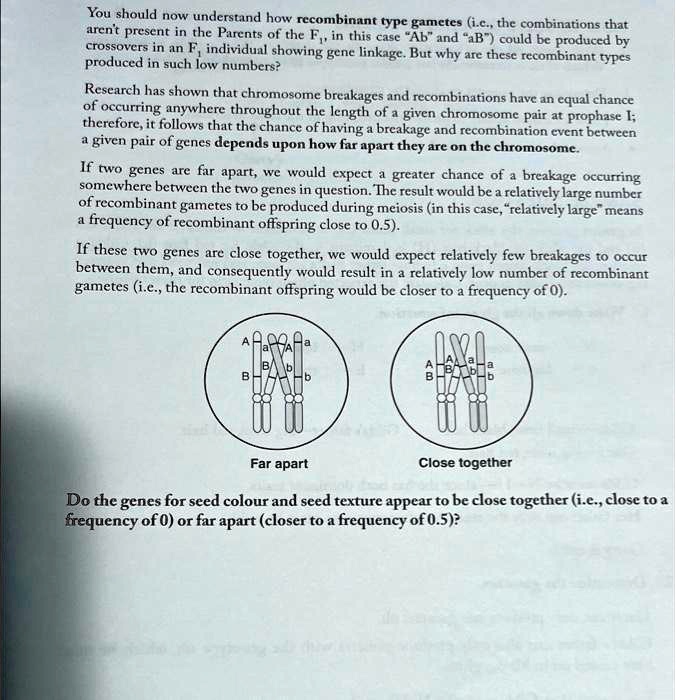
If two genes are far apart, we would expect a greater chance of a breakage occurring
somewhere between the two genes in question. The result would be a relatively large number
of recombinant gametes to be produced during meiosis (in this case, "relatively large" means
a frequency of recombinant offspring close to 0.5).
If these two genes are close together, we would expect relatively few breakages to occur
between them, and consequently would result in a relatively low number of recombinant
gametes (i.e., the recombinant offspring would be closer to a frequency of 0).
Do the genes for seed colour and seed texture appear to be close together (i.e., close to a
frequency of 0) or far apart (closer to a frequency of 0.5)?