Useful data or equations: Atmospheric pressure, Gravity, Water density, Air density, Water viscosity
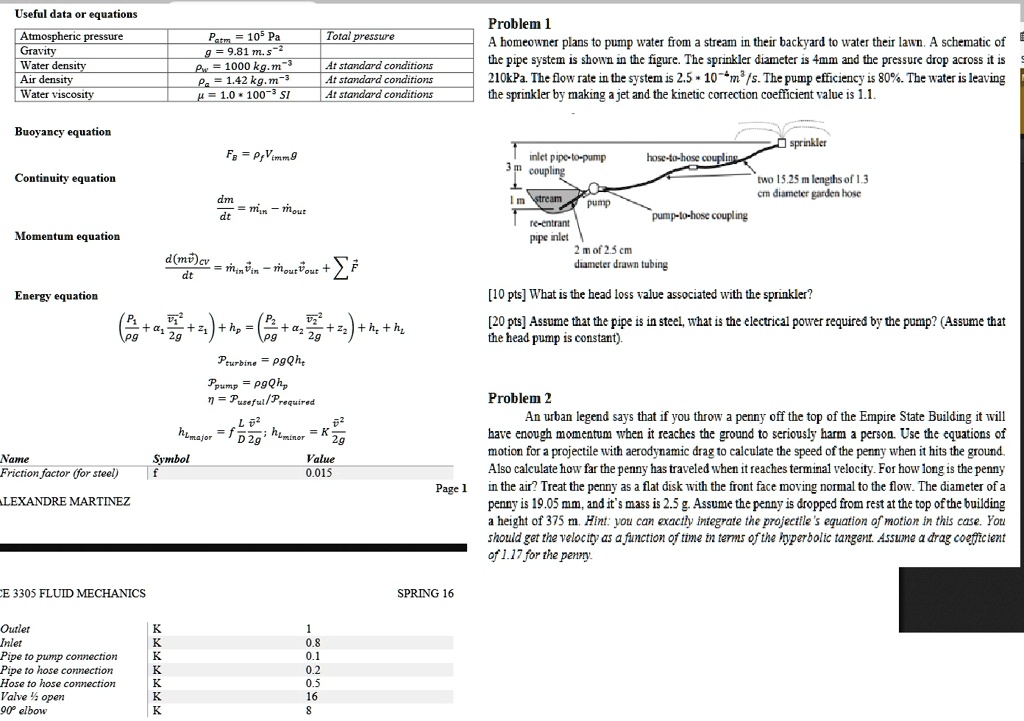
Problem 1: A homeowner plans to pump water from a stream in their backyard to water their lawn. A schematic of the system is shown below:
Parm = 10 Pa
g = 9.81 m/s^2
P = 1.42 kg/m^3
Ï = 1.0 * 1003 kg/m^3 (SI)
Total pressure at standard conditions = 210 kPa
Flow rate in the system = 2.5 * 10^3 m^3/s
Pump efficiency = 80%
Kinetic correction coefficient value = 1.1
Buoyancy equation: Fg = pVimm9
Inlet pipe to pump hose-to-hose coupling = 3 m
Coupling 1 m
Stream pump re-entrant pipe inlet = 2 m of 2.5 cm diameter drawn tubing
Continuity equation
Two 15.25 m lengths of 1.3 cm diameter garden hose
Momentum equation
Energy equation
[10 pts] What is the head loss value associated with the sprinkler?
+h + h
[20 pts] Assume that the pipe is made of steel, what is the electrical power required by the pump? (Assume that the head pump is constant).
Prurbine = pgQht
Ppump = pgQhp = Pusefut/Prequired
L2 2 hamajor = fD^2g hinor
Symbol Value
f = 0.015
Problem 2: An urban legend says that if you throw a penny off the top of the Empire State Building, it will have enough momentum when it reaches the ground to seriously harm a person. Use the equations of motion for a projectile with aerodynamic drag to calculate the speed of the penny when it hits the ground. Also, calculate how far the penny has traveled when it reaches terminal velocity. For how long is the penny in the air? Treat the penny as a flat disk with the front face moving normal to the flow. The diameter of a penny is 19.05 mm, and its mass is 2.5 g. Assume the penny is dropped from rest at the top of the building, a height of 375 m. Hint: you can exactly integrate the projectile's equation of motion in this case.
Name Friction factor (for steel)
Page 1
LEXANDRE MARTINEZ
of 1.17 for the penny
E3305 FLUID MECHANICS
SPRING 16
Outlet Inlet Pipe to pump connection Pipe to hose connection Hose to hose connection Valve % open 90 elbow
K = 0.8
K = 0.1
K = 0.2
K = 0.5
K = 16