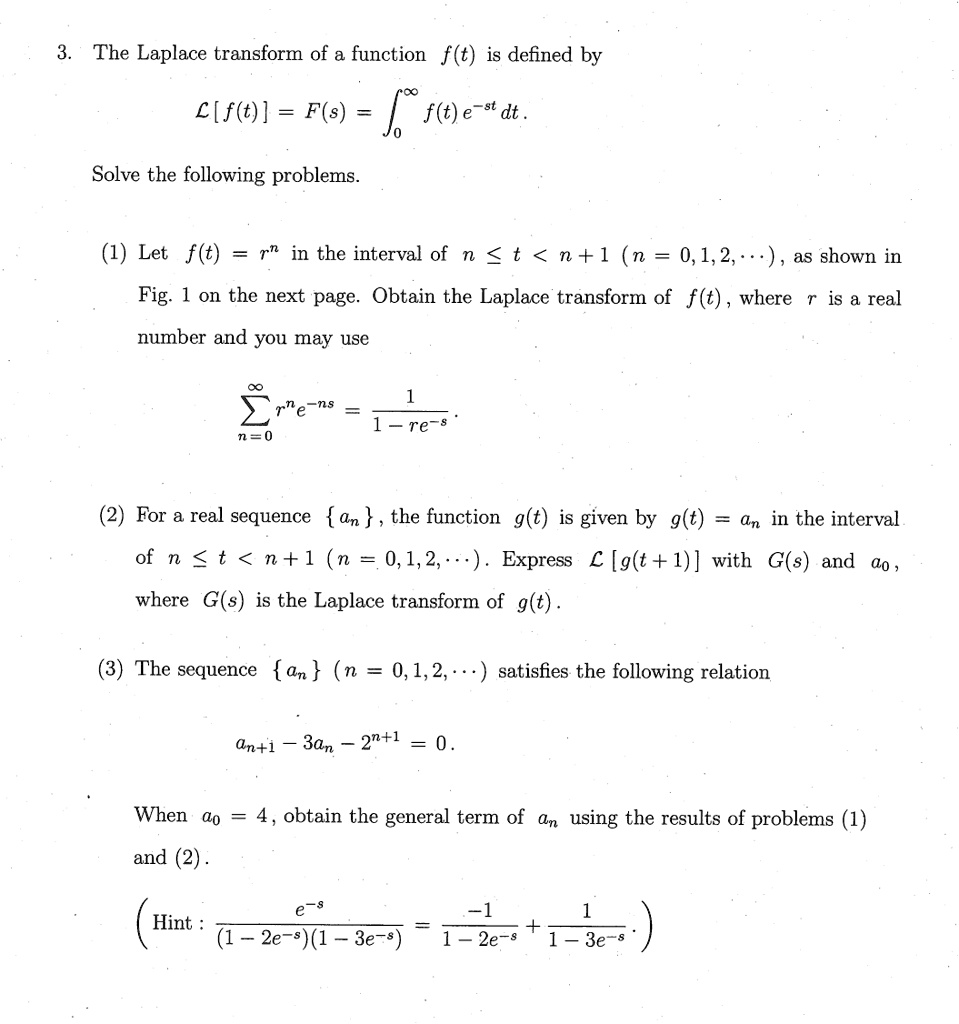
3. The Laplace transform of a function $f(t)$ is defined by
$\mathcal{L}[f(t)] = F(s) = \int_0^\infty f(t)e^{-st}dt$.
Solve the following problems.
(1) Let $f(t) = r^n$ in the interval of $n \le t < n+1$ ($n = 0, 1, 2, \dots$), as shown in
Fig. 1 on the next page. Obtain the Laplace transform of $f(t)$, where $r$ is a real
number and you may use
$\sum_{n=0}^\infty r^n e^{-ns} = \frac{1}{1 - re^{-s}}$.
(2) For a real sequence {$a_n$}, the function $g(t)$ is given by $g(t) = a_n$ in the interval
of $n \le t < n+1$ ($n = 0, 1, 2, \dots$). Express $\mathcal{L}[g(t+1)]$ with $G(s)$ and $a_0$,
where $G(s)$ is the Laplace transform of $g(t)$.
(3) The sequence {$a_n$} ($n = 0, 1, 2, \dots$) satisfies the following relation
$a_{n+1} - 3a_n - 2^{n+1} = 0$.
When $a_0 = 4$, obtain the general term of $a_n$ using the results of problems (1)
and (2).
$\text{Hint: } \left(\frac{e^{-s}}{(1 - 2e^{-s})(1 - 3e^{-s})} = \frac{-1}{1 - 2e^{-s}} + \frac{1}{1 - 3e^{-s}}\right)$