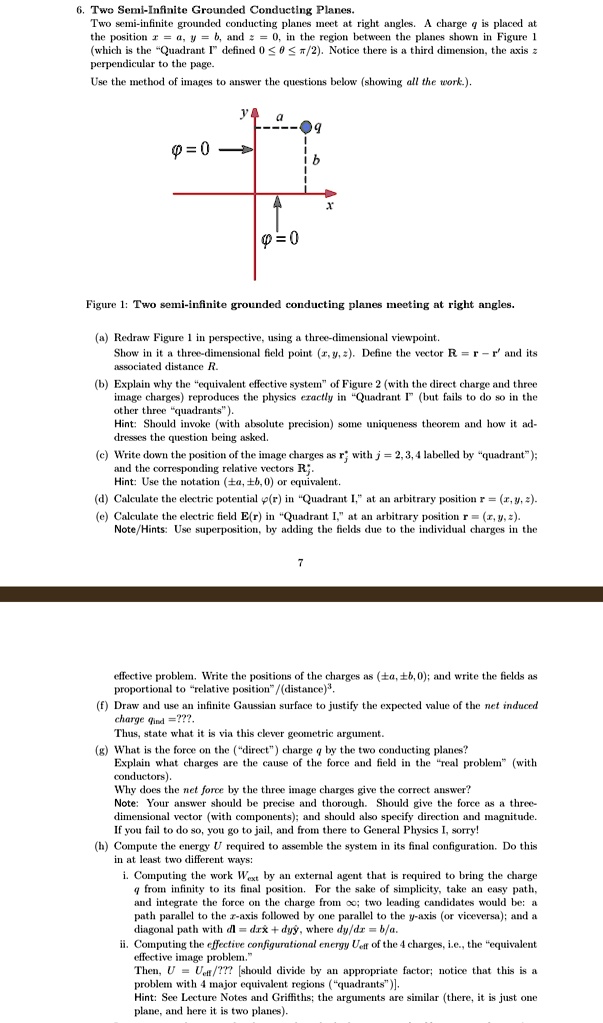
6. Two Semi-Infinite Grounded Conducting Planes.
Two semi-infinite grounded conducting planes meet at right angles. A charge q is placed at
the position $x = a$, $y = b$, and $z = 0$, in the region between the planes shown in Figure 1
(which is the "Quadrant I" defined $0 \le \theta \le \pi/2$). Notice there is a third dimension, the axis $z$
perpendicular to the page.
Use the method of images to answer the questions below (showing all the work.).
a
$\varphi = 0$
$\varphi = 0$
b
Figure 1: Two semi-infinite grounded conducting planes meeting at right angles.
(a) Redraw Figure 1 in perspective, using a three-dimensional viewpoint.
Show in it a three-dimensional field point $(x, y, z)$. Define the vector $\mathbf{R} = \mathbf{r} - \mathbf{r}'$ and its
associated distance $R$.
(b) Explain why the "equivalent effective system" of Figure 2 (with the direct charge and three
image charges) reproduces the physics exactly in "Quadrant I" (but fails to do so in the
other three "quadrants").
Hint: Should invoke (with absolute precision) some uniqueness theorem and how it ad-
dresses the question being asked.
(c) Write down the position of the image charges as $\mathbf{r}_j^*$ with $j = 2, 3, 4$ labelled by "quadrant");
and the corresponding relative vectors $\mathbf{R}_j^*$.
Hint: Use the notation $(\pm a, \pm b, 0)$ or equivalent.
(d) Calculate the electric potential $\varphi(\mathbf{r})$ in "Quadrant I," at an arbitrary position $\mathbf{r} = (x, y, z)$.
(e) Calculate the electric field $\mathbf{E}(\mathbf{r})$ in "Quadrant I," at an arbitrary position $\mathbf{r} = (x, y, z)$.
Note/Hints: Use superposition, by adding the fields due to the individual charges in the
7
effective problem. Write the positions of the charges as $(\pm a, \pm b, 0)$; and write the fields as
proportional to "relative position"/(distance)$^3$.
(f) Draw and use an infinite Gaussian surface to justify the expected value of the net induced
charge $q_{ind} = ???$.
Thus, state what it is via this clever geometric argument.
(g) What is the force on the ("direct") charge $q$ by the two conducting planes?
Explain what charges are the cause of the force and field in the "real problem" (with
conductors).
Why does the net force by the three image charges give the correct answer?
Note: Your answer should be precise and thorough. Should give the force as a three-
dimensional vector (with components); and should also specify direction and magnitude.
If you fail to do so, you go to jail, and from there to General Physics I, sorry!
(h) Compute the energy $U$ required to assemble the system in its final configuration. Do this
in at least two different ways:
i. Computing the work $W_{ext}$ by an external agent that is required to bring the charge
$q$ from infinity to its final position. For the sake of simplicity, take an easy path,
and integrate the force on the charge from $\infty$; two leading candidates would be: a
path parallel to the $x$-axis followed by one parallel to the $y$-axis (or viceversa); and a
diagonal path with $d\mathbf{l} = dx\hat{\mathbf{x}} + dy\hat{\mathbf{y}}$, where $dy/dx = b/a$.
ii. Computing the effective configurational energy $U_{eff}$ of the 4 charges, i.e., the "equivalent
effective image problem."
Then, $U = U_{eff}/???$ [should divide by an appropriate factor; notice that this is a
problem with 4 major equivalent regions ("quadrants")].
Hint: See Lecture Notes and Griffiths; the arguments are similar (there, it is just one
plane, and here it is two planes).