Stats
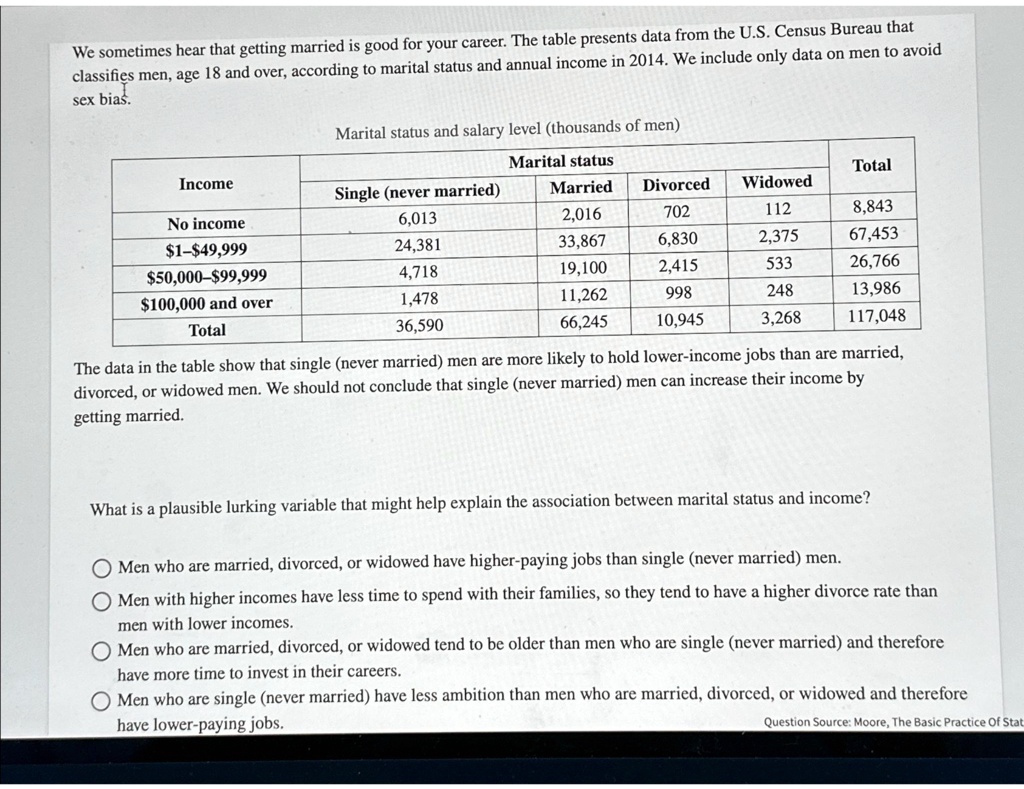
We sometimes hear that getting married is good for your career. The table presents data from the U.S. Census Bureau that classifies men, age 18 and over, according to marital status and annual income in 2014. We include only data on men to avoid sex bias. Marital status and salary level (thousands of men) Marital status Total Income Married Divorced Widowed Single (never married) 2,016 702 112 8,843 No income 6,013 33,867 6,830 2,375 67,453 $1$49,999 24,381 19,100 2,415 533 26,766 $50,000$99,999 4,718 11,262 998 248 13,986 $100,000 and over 1,478 66,245 10,945 3,268 117,048 Total 36,590 The data in the table show that single (never married) men are more likely to hold lower-income jobs than are married, divorced, or widowed men. We should not conclude that single (never married) men can increase their income by getting married.
What is a plausible lurking variable that might help explain the association between marital status and income?
O Men who are married, divorced, or widowed have higher-paying jobs than single (never married) men. O Men with higher incomes have less time to spend with their families, so they tend to have a higher divorce rate than men with lower incomes. O Men who are married, divorced, or widowed tend to be older than men who are single (never married) and therefore have more time to invest in their careers. O Men who are single (never married) have less ambition than men who are married, divorced, or widowed and therefore have lower-paying jobs. Question Source:Moore,The Basic Practice Of Sta