Ace - AI Tutor
Ask Our Educators
Textbooks
My Library
Flashcards
Scribe - AI Notes
Notes & Exams
Download App
miranda serra

miranda s.

Divider

Questions asked

BEST MATCH

(e) The formation of ammonia from nitrogen and hydrogen occurs by the following equation: \( \mathrm{N}_{2(\mathrm{~g})}+3 \mathrm{H}_{2(\mathrm{~g})} \rightleftharpoons 2 \mathrm{NH}_{3(\mathrm{~g})} ; \Delta \mathrm{H}^{\circ}=-92.22 \mathrm{~kJ} \) Does the amount of ammonia produced increase, decrease, or remain the same when a mixture of reactants and products at equilibrium undergoes the following changes? (i) The temperature decreases \( \qquad \) (ii) The volume is increased \( \qquad \) (iii) Argon is added \( \qquad \) (iv) \( \mathrm{N}_{2} \) is added \( \qquad \) Question five: (a) With mathematical expression in each case, state the; \( \qquad \)

View Answer
divider
BEST MATCH

100. Saying that the concentration of Total cyanide (CN) In drinking water is 0.05 mg/L, which is below the maximum allowable level of 0.07 mg/L as per DOH DAO No. 20070012 when it is actually above that limit is A. accurate C. precise B. false negative D. false positive

View Answer
divider
BEST MATCH

Which layer is generally the thickest in arteries? all layers are equally thick tunica intima tunica externa tunica media

View Answer
divider
BEST MATCH

Multiply. (5 + 8i)(4 + i) (5 + 8i)(4 + i) = (Simplify your answer. Type your answer in the form a + bi.)

View Answer
divider
BEST MATCH

Which hazardous substance is (or was) used in thermometers, dental fillings, batteries, and some ointments? A. Mercury B. Arsenic C. Lead D. Benzene

View Answer
divider
BEST MATCH

Write the form of the partial fraction decomposition for the following rational expression: \frac{3}{x^2 - 9x}

View Answer
divider
BEST MATCH

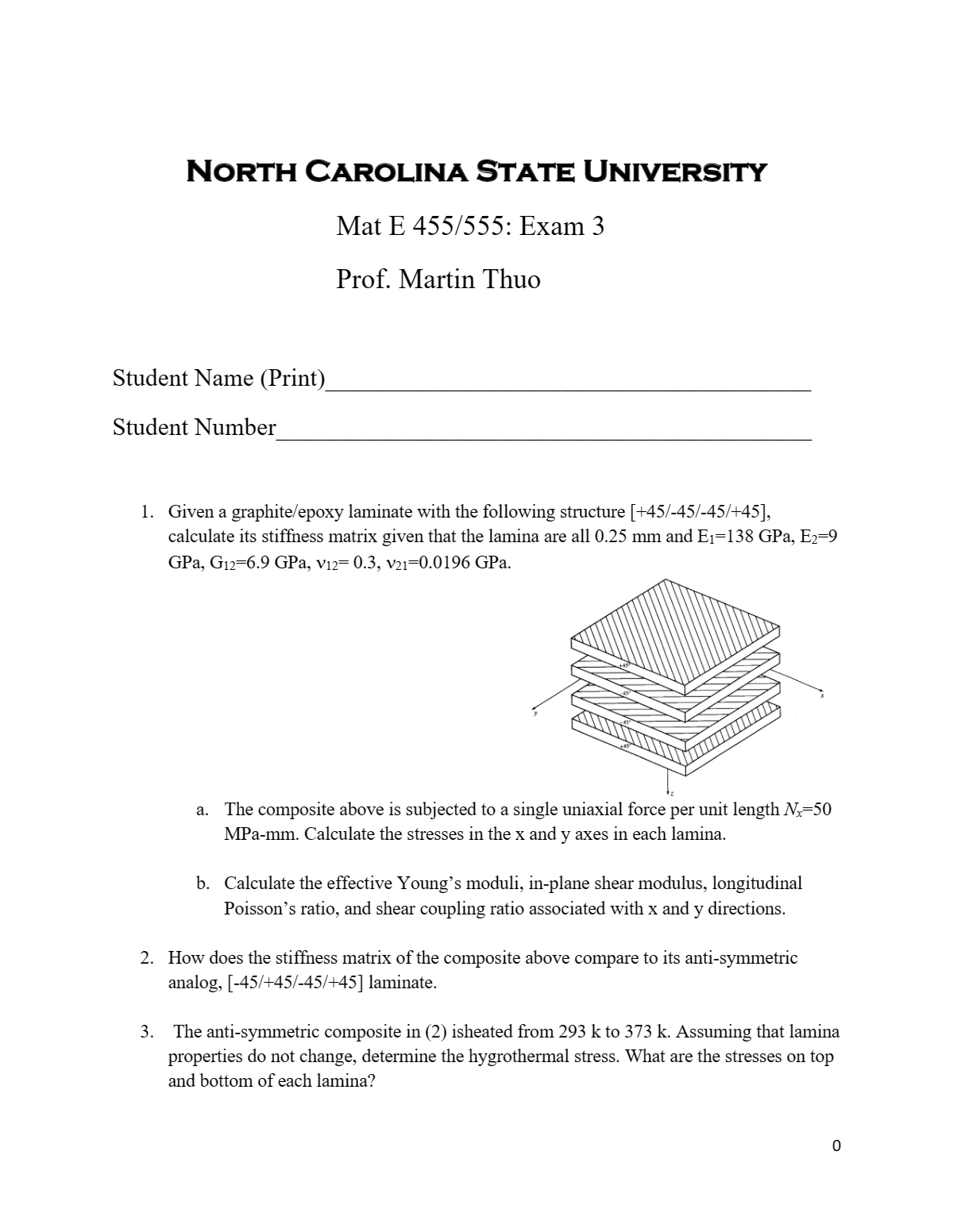
NORTH CAROLINA STATE UNIVERSITY Mat E 455/555: Exam 3 Prof. Martin Thuo Student Name (Print) Student Number \( \qquad \) 1. Given a graphite/epoxy laminate with the following structure [+45/-45/-45/+45], calculate its stiffness matrix given that the lamina are all \( 0.25 \mathrm{~mm} \) and \( \mathrm{E}_{1}=138 \mathrm{GPa}, \mathrm{E}_{2}=9 \) \( \mathrm{GPa}, \mathrm{G}_{12}=6.9 \mathrm{GPa}, v_{12}=0.3, v_{21}=0.0196 \mathrm{GPa} \). a. The composite above is subjected to a single uniaxial force per unit length \( N_{x}=50 \) \( \mathrm{MPa}-\mathrm{mm} \). Calculate the stresses in the \( \mathrm{x} \) and \( \mathrm{y} \) axes in each lamina. b. Calculate the effective Young's moduli, in-plane shear modulus, longitudinal Poisson's ratio, and shear coupling ratio associated with \( \mathrm{x} \) and \( \mathrm{y} \) directions. 2. How does the stiffness matrix of the composite above compare to its anti-symmetric analog, \( [-45 /+45 /-45 /+45] \) laminate. 3. The anti-symmetric composite in (2) isheated from \( 293 \mathrm{k} \) to \( 373 \mathrm{k} \). Assuming that lamina properties do not change, determine the hygrothermal stress. What are the stresses on top and bottom of each lamina? 0
View Answer
divider
BEST MATCH

5. On this page, partial credit is available. (a) Let $l$ be the line with parametric equation $\begin{pmatrix} 2\\3\\0 \end{pmatrix} + t \begin{pmatrix} 1\\-1\\1 \end{pmatrix}$ and let $P$ be the plane with equation $x + 3y + z = 8$. Find the intersection of $l$ and $P$. (b) Let $x = \begin{pmatrix} 1\\-2 \end{pmatrix}$ and $a = \begin{pmatrix} 1\\1 \end{pmatrix}$. Compute $x// (with respect to $a$). (c) With $x$ and $a$ as in part (b), compute the angle between those vectors. You do not need to simplify any arccos or arcsin value that arises in your answer.

View Answer
divider
BEST MATCH

A closed loop encloses several current-carrying wires with currents in different directions. The line integral $\oint \vec{B} \cdot d\vec{l}$ around the curve is $3.6 \times 10^{-3}$ T \cdot m. Determine the net current through the loop.

View Answer
divider
BEST MATCH

Question 40, 5.6.VQ-4 Watch the video and then solve the problem given below. Click here to watch the video. Use an identity to write the expression as a single trigonometric func $\pm \sqrt{\frac{1 + \cos 22x}{2}}$ $\pm \sqrt{\frac{1 + \cos 22x}{2}} = \square$ (Simplify your answer.)

View Answer
divider