Ace - AI Tutor
Ask Our Educators
Textbooks
My Library
Flashcards
Scribe - AI Notes
Notes & Exams
Download App
mireia peterson

mireia p.

Divider

Questions asked

BEST MATCH

Using the table below and a benchmark year of 1990, what is the output index for 1985? YEAR CORN PRODUCTION (TONS) OUTPUT INDEX PRICE OF CORN ($/TON) PRICE INDEX 1985 3,675 $0.675 1990 4,675 1.00 $0.795 1.000 1997 5,245 $0.987 0.79 0.85 0.82 0.75

View Answer
divider
BEST MATCH

To what time period does management's assessment of the effectiveness of internal control over financial reporting apply?

View Answer
divider
BEST MATCH

21 In order to discount multiple cash flows to the present, one would use Multiple Choice 1 points eBook the appropriate simple rate. the appropriate compound rate. the appropriate tax rate. the appropriate discount rate.

View Answer
divider
BEST MATCH

_(_____________ is the trade of things of value between buyer and seller so that each is better off after the trade. Barter Exchange Gold Money)

View Answer
divider
BEST MATCH

Q2. Consider a unity feedback system with open loop transfer function G(s) = \frac{K(s^2 - 2s + 2)}{s(s + 1)(s + 2)(s + 4)} a. Draw the root-locus with respect to K? 0 with all the details (break-away/in points, imaginary axis crossings). b. Find the location of all closed-loop poles for the K? 0 value(s) at which there are closed-loop poles on the imaginary axis. c. What is the range of K? 0 for the stability of the closed-loop system. d. What is the range of values of K? 0 for which no oscillations are observed in the step response of the closed-loop system? e. Calculate analytically the value of K? 0 at which there are two complex closed-loop poles with real part -4. What is(are) the frequency(frequencies) of oscillations observed in the step response of the system at this K value? f. Describe how you can analytically find the value of K? 0 at which the step response of the closed- loop system has oscillations with frequency 3 rad/sec (No actual calculations are necessary). Show the related point on the root locus. Note: In this question, feel free to use any computer tool for calculating the roots of high-order polynomials.

View Answer
divider
BEST MATCH

Alpha should specialize in producing pineapples. Beta should specialize in producing pearls. Alpha would produce 0 tons of pearls and 30 tons of pineapples. Beta would produce 40 tons of pearls and 0 tons of pineapples. The combined production for the two islands would increase by 10 tons of pearls and 10 tons of pineapples.

View Answer
divider
BEST MATCH

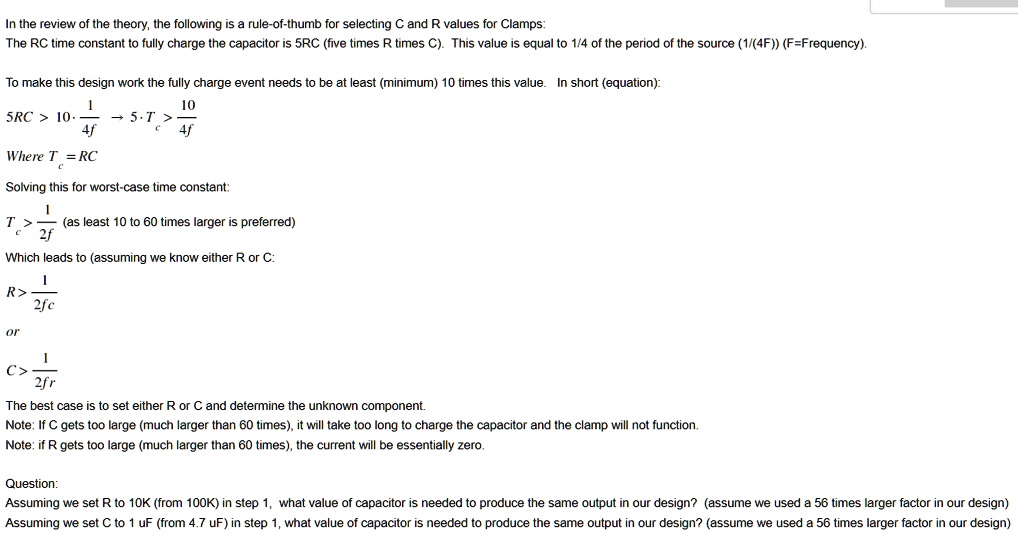
In the review of the theory, the following is a rule-of-thumb for selecting C and R values for Clamps: The RC time constant to fully charge the capacitor is 5RC (five times R times C). This value is equal to 1/4 of the period of the source (1/(4F)) (F=Frequency). To make this design work the fully charge event needs to be at least (minimum) 10 times this value. In short (equation): $5RC > 10 \cdot \frac{1}{4f} \implies 5 \cdot T_c > \frac{10}{4f}$ Where $T_c = RC$ Solving this for worst-case time constant: $T_c > \frac{1}{2f}$ (as least 10 to 60 times larger is preferred) Which leads to (assuming we know either R or C: $R > \frac{1}{2fc}$ or $C > \frac{1}{2fr}$ The best case is to set either R or C and determine the unknown component. Note: If C gets too large (much larger than 60 times), it will take too long to charge the capacitor and the clamp will not function. Note: if R gets too large (much larger than 60 times), the current will be essentially zero. Question: Assuming we set R to 10K (from 100K) in step 1, what value of capacitor is needed to produce the same output in our design? (assume we used a 56 times larger factor in our design) Assuming we set C to 1 uF (from 4.7 uF) in step 1, what value of capacitor is needed to produce the same output in our design? (assume we used a 56 times larger factor in our design)
View Answer
divider
BEST MATCH

7. (EXTRA 15 POINT) The circuit shown below is a difference amplifier. Assuming that the op-am is ideal, design this circuit so that it has a difference gain of 100, a differential input resistance of 20??, and a minimum CMRR of 80dB.

View Answer
divider
BEST MATCH

In the section illustrated in Figure P3-51 the surface 1-4-7 is insulated. The convection heat transfer coefficient at surface 1-2-3 is 28 W/m² · °C. The thermal conductivity of the solid material is 5.2 W/m · °C. Using the numerical technique, compute the temperatures at nodes 1, 2, 4, and 5. Figure P3-51 Insulated T? = 0°C h = 28 W/m² · °C 30 cm 30 cm T7 = T8 = T9 = 38°C T3 = T6 = 10°C

View Answer
divider
BEST MATCH

Problem 6 Find the Y-parameters of the following network. $I_1$ $L_1$ $V_1$ $\alpha I_2$ $\beta I_1$ $L_2$ $I_2$ $V_2$

View Answer
divider