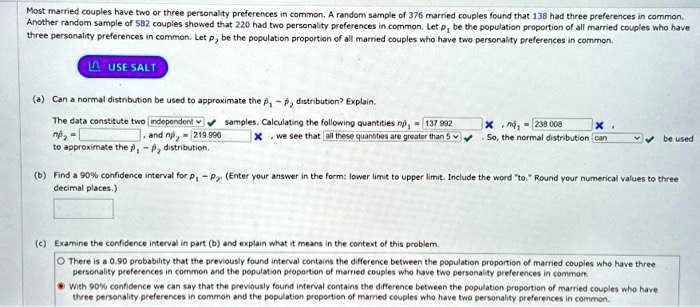
Most married couples have two or three personality preferences in common. A random sample of 376 married couples found that 138 had three preferences in common.
Another random sample of 582 couples showed that 220 had two personality preferences in common. Let $p_1$ be the population proportion of all married couples who have
three personality preferences in common. Let $p_2$ be the population proportion of all married couples who have two personality preferences in common.
USE SALT
(a) Can a normal distribution be used to approximate the $p_1 - p_2$ distribution? Explain.
The data constitute two independent samples. Calculating the following quantities $n_1p_1 = 137.992$, $n_1(1 - p_1) = 238.008$, $n_2p_2 = 219.990$ ,
we see that all these quantities are greater than 5. So, the normal distribution can be used
to approximate the $p_1 - p_2$ distribution.
(b) Find a 90% confidence interval for $p_1 - p_2$. (Enter your answer in the form: lower limit to upper limit. Include the word "to." Round your numerical values to three
decimal places.)
(c) Examine the confidence interval in part (b) and explain what it means in the context of this problem.
There is a 0.90 probability that the previously found interval contains the difference between the population proportion of married couples who have three
personality preferences in common and the population proportion of married couples who have two personality preferences in common
With 90% confidence we can say that the previously found interval contains the difference between the population proportion of married couples who have
three personality preferences in common and the population proportion of married couples who have two personality preferences in common.