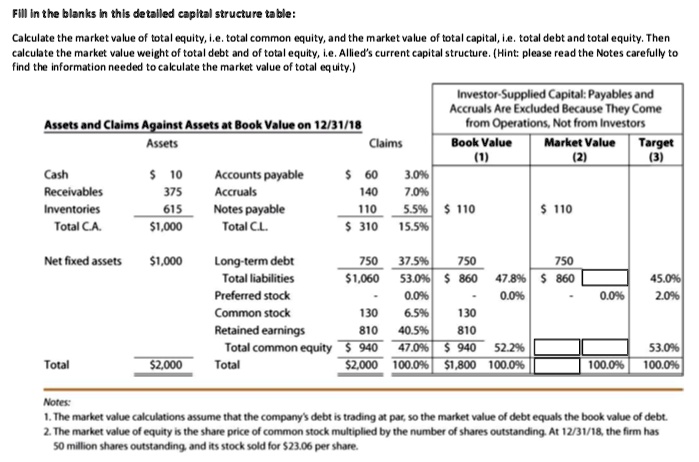
Fill in the blanks in this detailed capital structure table:
Calculate the market value of total equity, i.e. total common equity, and the market value of total capital, i.e. total debt and total equity. Then
calculate the market value weight of total debt and of total equity, i.e. Allied's current capital structure. (Hint: please read the Notes carefully to
find the information needed to calculate the market value of total equity.)
Assets and Claims Against Assets at Book Value on 12/31/18
Investor-Supplied Capital: Payables and
Accruals Are Excluded Because They Come
from Operations, Not from Investors
Assets
Claims
Book Value
(1)
Market Value
(2)
Target
(3)
Cash
$ 10
Accounts payable
$ 60 3.0%
Receivables
375
Accruals
140
7.0%
Inventories
615
Notes payable
110
5.5% $ 110
Total C.A.
$1,000
Total C.L.
$ 310
15.5%
$ 110
Net fixed assets
$1,000
Long-term debt
750 37.5% 750
750
Total liabilities
$1,060 53.0% $ 860
47.8% $ 860
Preferred stock
- 0.0%
- 0.0%
0.0%
45.0%
2.0%
Common stock
130
6.5%
130
Retained earnings
810
40.5%
810
Total common equity $ 940
47.0%
$ 940
52.2%
53.0%
Total
$2,000
Total
$2,000
100.0%
$1,800 100.0%
100.0%
100.0%
Notes:
1. The market value calculations assume that the company's debt is trading at par, so the market value of debt equals the book value of debt.
2. The market value of equity is the share price of common stock multiplied by the number of shares outstanding. At 12/31/18, the firm has
50 million shares outstanding, and its stock sold for $23.06 per share.