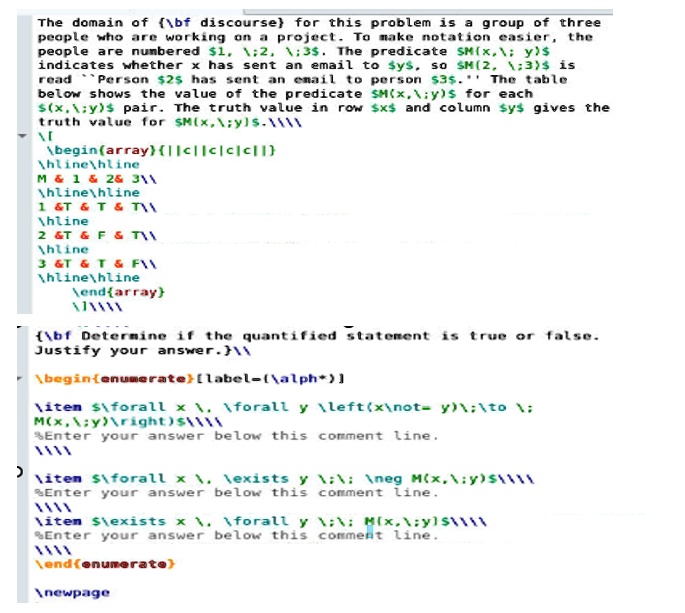
The domain of $\textbf{discourse}$ for this problem is a group of three people who are working on a project. To make notation easier, the people are numbered $1, 2, 3$. The predicate $M(x, y)$ indicates whether x has sent an email to y, so $M(2, 3)$ is read "Person $2$ has sent an email to person $3$." The table below shows the value of the predicate $M(x, y)$ for each $(x, y)$ pair. The truth value in row $x$ and column $y$ gives the truth value for $M(x, y)$.
\begin{array}{|c||c|c|c|}
\hline\hline
M & 1 & 2 & 3 \\
\hline\hline
1 & T & T & T \\
\hline
2 & T & F & T \\
\hline
3 & T & T & F \\
\hline\hline
\end{array}
$\textbf{Determine if the quantified statement is true or false. Justify your answer.}$
\begin{enumerate}[label=(\alph*)]
\item $\forall x, \forall y (x \neq y \to M(x, y))$
%Enter your answer below this comment line.
\item $\forall x, \exists y (\neg M(x, y))$
%Enter your answer below this comment line.
\item $\exists x, \forall y (M(x, y))$
%Enter your answer below this comment line.
\end{enumerate}
\newpage