Ace - AI Tutor
Ask Our Educators
Textbooks
My Library
Flashcards
Scribe - AI Notes
Notes & Exams
Download App
misty agust-

misty a.

Divider

Questions asked

BEST MATCH

10. (p.118/#4.15) Assume that two random variables ($X$, $Y$) are uniformly distributed on a circle with radius $a$. Then the joint probability density function is $$ f(x, y) = \begin{cases} \frac{1}{\pi a^2}, & x^2 + y^2 \le a^2, \\ 0, & \text{elsewhere}. \end{cases} $$ Find $\mu_x$, the Expected Value of $X$.

View Answer
divider
BEST MATCH

draw a reaction scheme illustrating the reaction of a generic carboxylic acid (RCO2H) with hydroxide ion, and a second reaction scheme showing the conversion of the sodium salt of the acid to the acidic form using HCl

View Answer
divider
BEST MATCH

In the coronal plane of the brain:is the grey matter mainly on the outside or inside?

View Answer
divider
BEST MATCH

$\begin{bmatrix} 1 & 0 & 0 \ 4 & 1 & 0 \ 3 & 3 & 1 \end{bmatrix} \begin{bmatrix} -2 \ 0 \ 4 \end{bmatrix} \begin{bmatrix} -4 \ -3 \ 0 \end{bmatrix} \begin{bmatrix} -2 \ 0 \ 4 \end{bmatrix}, b = \begin{bmatrix} -6 \ -30 \ -32 \end{bmatrix}$ To find the solution to $Ax = b$ using the LU factorization, we would first solve the system $Ly = $ $and then solve the system $Ux = $ the second system yields the solution: $x = $

View Answer
divider
BEST MATCH

Is it ethical for the auto industry to no longer produce big cars and go green?

View Answer
divider
BEST MATCH

10.2-Using the information below, test the significance of the data: A company has three manufacturing plants, and company leaders want to determine whether there is a significant difference (use $\alpha = .01$) in the average age of workers at the three locations. The following data is the average age of five randomly selected workers at each plant. The data and the partial results of a one-way ANOVA table are listed below: Employees' Ages (in Years) Plant 1 Plant 2 Plant 3 29 32 25 27 33 24 30 31 24 27 34 25 28 30 26 $N = 15$ $\bar{X} = 28.33$ $n_1 = 5$ $n_2 = 5$ $n_3 = 5$ $\bar{x}_1 = 28.2$ $\bar{x}_2 = 32.0$ $\bar{x}_3 = 24.8$ Source of Variance df SS MS F Between ? 129.73 64.87 ? Within ? 19.60 1.63 Total 14 149.33 1. In the table, what is $df_B$? 2. In the table, what is $df_W$? 3. In the table, what is $F_{OBS}$? 4. At $\alpha = .01$, what is your $F_{CRIT}$? 5. What is your research decision - accept $H_0$ or reject $H_0$?

View Answer
divider
BEST MATCH

Formed output using PORTB Answer the following: a. Give the start addresses for (i) messages and (ii) code. b. Rewrite the instructions CMP #'0' and CMP #'9' by removing the single quotes and making appropriate changes c. Do the conditional branch instructions in the code use signed or unsigned tests? d. Which register will contain the user-entered input? e. In the code, why is $30 subtracted from the value in accumulator B? f. Which memory address will the user-entered input be stored and why that address?

View Answer
divider
BEST MATCH

The routing formulation is given by (4.26): $\max_x \quad u_w$ subject to: $\sum_{e \in \delta^+(n)} x_{des} - \sum_{e \in \delta^-(n)} x_{des} = \begin{cases} 1, \text{if } n = a(d) \ -1, \text{if } n = b(d) \ 0, \text{otherwise} \end{cases}$ $\forall d \in D, n \in N, s \in S$ $\sum_d h_d x_{des} \le u_e - u_w$, $\forall e \in E, s \in S$ $x_{des} = 0$, $\forall d \in D, s \in S, e \in E(s)$ Rewrite the formulation (4.26) using a flow-path approach. Add the constraint that demands unaffected by a failure cannot change its routing.

View Answer
divider
BEST MATCH

Clara purchases two products with a given fixed budget, orange juice and soda. Her marginal utility from orange juice is 60 and her marginal utility from soda is 30. The price of a bottle of orange juice is $2.00 and the price of soda is $1.00. These data suggest that: Clara should buy less orange juice and soda Clara should buy more orange juice and less soda Clara should buy more soda and less orange juice Clara is maximizing her utility from the given fixed budget

View Answer
divider
BEST MATCH

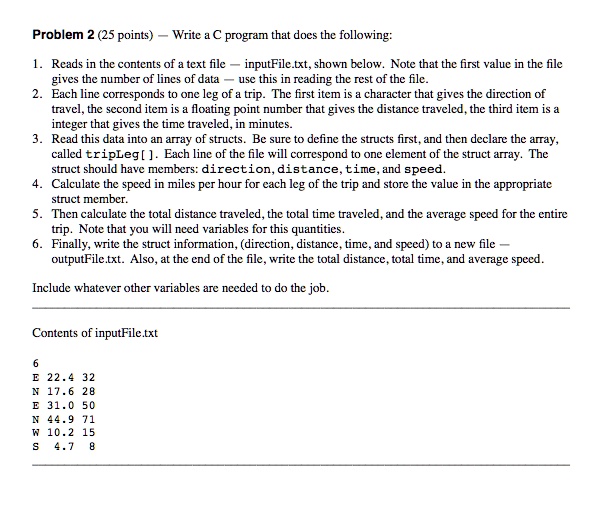
Problem 2 (25 points) Write a C program that does the following: 1. Reads in the contents of a text file \texttt{inputFile.txt}, shown below. Note that the first value in the file gives the number of lines of data -- use this in reading the rest of the file. 2. Each line corresponds to one leg of a trip. The first item is a character that gives the direction of travel, the second item is a floating point number that gives the distance traveled, the third item is a integer that gives the time traveled, in minutes. 3. Read this data into an array of structs. Be sure to define the structs first, and then declare the array, called \texttt{tripLeg[]} . Each line of the file will correspond to one element of the struct array. The struct should have members: direction, distance, time, and speed. 4. Calculate the speed in miles per hour for each leg of the trip and store the value in the appropriate struct member. 5. Then calculate the total distance traveled, the total time traveled, and the average speed for the entire trip. Note that you will need variables for this quantities. 6. Finally, write the struct information, (direction, distance, time, and speed) to a new file -- \texttt{outputFile.txt}. Also, at the end of the file, write the total distance, total time, and average speed. Include whatever other variables are needed to do the job. Contents of inputFile.txt 6 E 22.4 32 N 17.6 28 E 31.0 50 N 44.9 71 W 10.2 15 S 4.7 8
View Answer
divider