Ace - AI Tutor
Ask Our Educators
Textbooks
My Library
Flashcards
Scribe - AI Notes
Notes & Exams
Download App
Mitchell Jackson

Mitchell J.

Divider

Viewed Questions

Use double integrals to calculate the areas of the surfaces.
The part of the plane $z=2 x+2 y$ inside the cylinder $x^{2}+y^{2}=1$

Use double integrals to calculate the areas of the surfaces. The part of the plane $z=2 x+2 y$ inside the cylinder $x^{2}+y^{2}=1$

Calculus A Complete Course

Multiple Integration

Applications of Multiple Integrals

Evaluate $\iiint_{R}\left(x^{2}+y^{2}+z^{2}\right) d V,$ where $R$ is the cylinder $0 \leq x^{2}+y^{2} \leq a^{2}, 0 \leq z \leq h$.

Calculus A Complete Course

Multiple Integration

Change of Variables in Triple Integrals

Find the volumes of the indicated regions.Inside the cone $z=\sqrt{x^{2}+y^{2}}$ and inside the sphere $x^{2}+y^{2}+z^{2}=a^{2}$.

Calculus A Complete Course

Multiple Integration

Change of Variables in Triple Integrals

Find the volume fying berween the paraboloids $z=x^{2}+y^{2}$ and $3 z=4-x^{2}-y^{2}$.

Calculus: A Complete Course

Multiple Integration

Double Integrals in Polar Coordinates

Questions asked

INSTANT ANSWER

Kuva: Matias Jääskeläinen (2020), "Re-ja Im- akselit" (c) Ex-nx-:m Kompleksiluvut \( z=a+b i \) tunnistaa imaginaariosan symbolista \( i \). Trigonometrian kaavoja hy?dyntämäll? kompleksiluvut voidaan ilmoittaa myös seuraavasti: \( r e^{i \theta} \), jossa \( r=\sqrt{a^{2}+b^{2}} \theta=\tan ^{-1} \frac{b}{a} \) Eulerin kaavaa hyödyntämällä kompleksiluvut voidaan ilmaista \( z=r e^{i \theta}=r(\cos \theta+i \sin \theta) \). l) Näit? kaavoja hyödyntämällä täydennä seuraavat kompleksiluvut: Tarvitset mahdollisesti seuraavia merkint?j?: \( i \rightarrow{ }^{\prime} \mathrm{i}^{\prime} \) \( \theta \rightarrow \) 'theta' \( \sqrt{x} \rightarrow{ }^{\prime} \operatorname{sqrt}(x)^{\prime} \) \( \pi \rightarrow^{\prime} p i^{\prime} \) \( e^{x y} \rightarrow{ }^{\prime} \mathrm{e}^{\wedge}\left(x^{*} y\right)^{\prime} \) a) \( \square \) \( + \) \( \square \) \( i=\sqrt{2} e^{\frac{5 \pi}{4} i}= \) \( \square \) ( \( \cos \) \( \square \) \( +i \sin \) \( \square \) ) b) \( \square \) \( + \) \( \square \) \( i=e^{2 \pi i}= \) \( \square \) ( \( \cos \) \( \square \) \( +i \sin \) \( \square \) ) Kompleksiluvun kompleksikonjugaatti \( z^{*} \) muodostetaan vaihtamalla kompleksiluvun imaginaariosan merkki: \( z^{*}=\boldsymbol{a}-\boldsymbol{b} \boldsymbol{i} \) II) Muodosta seuraavien kompleksilukujen kompleksikonjugaatit: a) \( z=1+\sqrt{3} i \Rightarrow z^{*}= \) \( \square \) b) \( z=e^{\theta i} \Rightarrow z^{*}= \) \( \square \)

View Answer
divider
INSTANT ANSWER

Kuva: Matias Jääskeläinen (2020), "Re-ja Im- akselit" (c) Ex-nx-:m Kompleksiluvut \( z=a+b i \) tunnistaa imaginaariosan symbolista \( i \). Trigonometrian kaavoja hy?dyntämäll? kompleksiluvut voidaan ilmoittaa myös seuraavasti: \( r e^{i \theta} \), jossa \( r=\sqrt{a^{2}+b^{2}} \theta=\tan ^{-1} \frac{b}{a} \) Eulerin kaavaa hyödyntämällä kompleksiluvut voidaan ilmaista \( z=r e^{i \theta}=r(\cos \theta+i \sin \theta) \). l) Näit? kaavoja hyödyntämällä täydennä seuraavat kompleksiluvut: Tarvitset mahdollisesti seuraavia merkint?j?: \( i \rightarrow{ }^{\prime} \mathrm{i}^{\prime} \) \( \theta \rightarrow \) 'theta' \( \sqrt{x} \rightarrow{ }^{\prime} \operatorname{sqrt}(x)^{\prime} \) \( \pi \rightarrow^{\prime} p i^{\prime} \) \( e^{x y} \rightarrow{ }^{\prime} \mathrm{e}^{\wedge}\left(x^{*} y\right)^{\prime} \) a) \( \square \) \( + \) \( \square \) \( i=\sqrt{2} e^{\frac{5 \pi}{4} i}= \) \( \square \) ( \( \cos \) \( \square \) \( +i \sin \) \( \square \) ) b) \( \square \) \( + \) \( \square \) \( i=e^{2 \pi i}= \) \( \square \) ( \( \cos \) \( \square \) \( +i \sin \) \( \square \) ) Kompleksiluvun kompleksikonjugaatti \( z^{*} \) muodostetaan vaihtamalla kompleksiluvun imaginaariosan merkki: \( z^{*}=\boldsymbol{a}-\boldsymbol{b} \boldsymbol{i} \) II) Muodosta seuraavien kompleksilukujen kompleksikonjugaatit: a) \( z=1+\sqrt{3} i \Rightarrow z^{*}= \) \( \square \) b) \( z=e^{\theta i} \Rightarrow z^{*}= \) \( \square \)

View Answer
divider
ANSWERED

George Bennett verified

Numerade educator

c) Draw a curly arrow mechanism that shows how the diol J transforms into the cyclic compound K in the presence of an acid catalyst (HA). Draw all the necessary curly arrows, structures of intermediates, formal charges, and relevant lone electron pairs. Pay attention to the technique of drawing curly arrows – use the rules learned in this course. Hint: number the carbon atoms. (5 p)

View Answer
divider
ANSWERED

George Bennett verified

Numerade educator

a) Draw a curly arrow mechanism which explains the formation of product G. Draw all the necessary curly arrows, structures of intermediates, formal charges and relevant lone electron pairs. Pay attention to the technique of drawing curly arrows – use the rules learned in this course. (5 p)

View Answer
divider
ANSWERED

George Bennett verified

Numerade educator

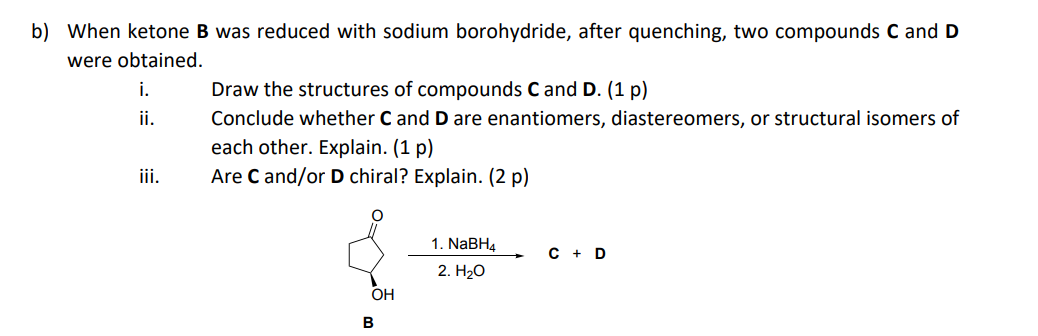
b) When ketone B was reduced with sodium borohydride, after quenching, two compounds C and D were obtained. i. Draw the structures of compounds C and D. (1 p) ii. Conclude whether C and D are enantiomers, diastereomers, or structural isomers of each other. Explain. (1 p) iii. Are C and/or D chiral? Explain. (2 p)
View Answer
divider
INSTANT ANSWER

a) Study the compound \( \mathbf{A} \). i. Draw all lone electron pairs. (1 p) ii. Determine the highest energy occupied orbital (HOMO) by comparing it to other relevant occupied orbitals - use orbital energy diagrams if necessary. Justify your conclusion. Grading is based on the logic of your reasoning. (2 p) iii. Determine the lowest energy unoccupied orbital (LUMO) by comparing it to other relevant unoccupied orbitals - use orbital energy diagrams if necessary. Justify your conclusion. Grading is based on the logic of your reasoning. (2 p)

View Answer
divider
ANSWERED

George Bennett verified

Numerade educator

Bonus. Ethene C2H4 is planar, but in the boron analogue B2H4 is not – the BH2 halves of the molecule are perpendicular to each other. Explain the difference using necessary drawings/orbitals/interactions. (5 p)

View Answer
divider
ANSWERED

George Bennett verified

Numerade educator

b) The following reaction series is part of the total synthesis of Stemona alkaloids by Aub

View Answer
divider
ANSWERED

Shalini Tyagi verified

Numerade educator

a) Draw a curly arrow mechanism which explains the formation of product G. Draw all the necessary curly arrows, structures of intermediates, formal charges and relevant lone electron pairs. Pay attention to the technique of drawing curly arrows – use the rules learned in this course. (5 p)

View Answer
divider
ANSWERED

George Bennett verified

Numerade educator

c) If compounds E and F are mixed at the same temperature with potassium tert-butoxide, E reacts quickly but F does not react at all. Explain this difference using the necessary drawings/curly arrows. (5 p)

View Answer
divider