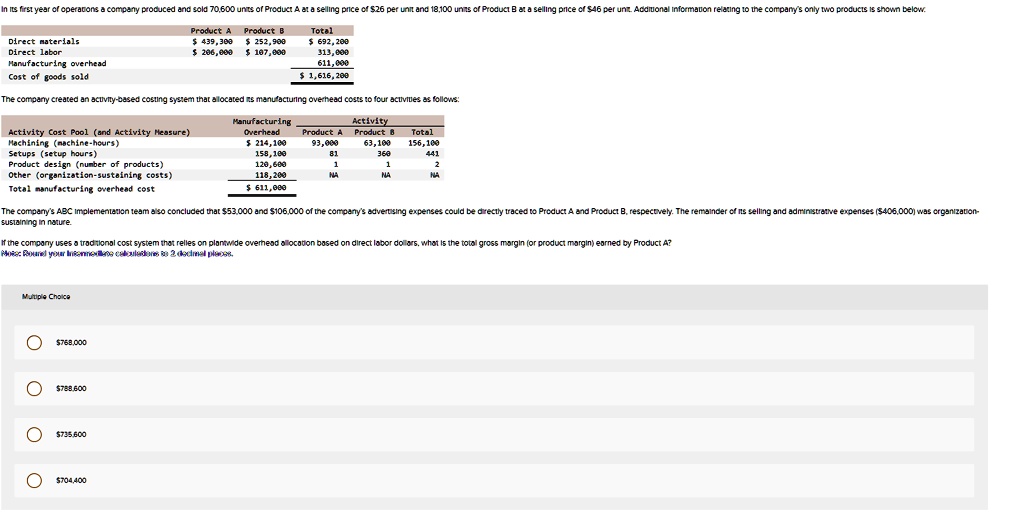
In Its first year of operations a company produced and sold 70,600 units of Product A at a selling price of $26 per unit and 18,100 units of Product B at a selling price of $46 per unit. Additional information relating to the company's only two products is shown below.
Direct materials
Direct labor
Manufacturing overhead
Cost of goods sold
Product A
Product B
Total
$\ 439,300
$\ 252,900
$\ 692,200
$\ 206,000
$\ 107,000
$\ 313,000
$\ 611,000
$\ 1,616,200
The company created an activity-based costing system that allocated its manufacturing overhead costs to four activities as follows:
Manufacturing
Activity
Activity Cost Pool (and Activity Measure)
Overhead
Product A
Product B
Total
Machining (machine-hours)
$\ 214,100
93,000
63,100
156,100
Setups (setup hours)
$\ 158,100
81
360
441
Product design (number of products)
$\ 120,600
1
1
2
Other (organization-sustaining costs)
$\ 118,200
NA
NA
NA
Total manufacturing overhead cost
$\ 611,000
The company's ABC Implementation team also concluded that $53,000 and $106,000 of the company's advertising expenses could be directly traced to Product A and Product B, respectively. The remainder of its selling and administrative expenses ($406,000) was organization-
sustaining in nature.
If the company uses a traditional cost system that relies on plantwide overhead allocation based on direct labor dollars, what is the total gross margin (or product margin) earned by Product A?
Note: Round your intermediate calculations to 2 decimal places.
Multiple Choice
$\ 768,000
$\ 788,600
$\ 735,600
$\ 704,400