Ace - AI Tutor
Ask Our Educators
Textbooks
My Library
Flashcards
Scribe - AI Notes
Notes & Exams
Download App
mohamed powell

mohamed p.

Divider

Questions asked

BEST MATCH

Find the change in profit P for the given marginal. Assume that the number of units x increases by 2 from the specified value of x. (Round your answer to two decimal places.) Marginal Number of Units, x dP/dx = 12.1(50 − 3x^1/2) x = 121

View Answer
divider
BEST MATCH

Chairs have been set up for an event. There are 11 rows of chairs with 12 chairs in each row. When the event is over, the chairs are put away on chair racks. If each chair rack holds exactly 9 chairs, what is the fewest number of chair racks needed to hold all of the chairs? Explain how you know your answer is correct.

View Answer
divider
BEST MATCH

Question 9 An acceleration in the positive direction always means that a moving object is speeding up. True False 0.5 pts

View Answer
divider
BEST MATCH

Changes in ____ represent the predominant cause for biological evolution. Multiple Choice homeostasis growth and development reproduction genetic makeup energy

View Answer
divider
BEST MATCH

When you burn 1 mole of $C_4H_8$, you would need moles of $O_2$, and you would produce moles of carbon dioxide and moles of water. (Hint: Balance the combustion reaction on scratch paper and then fill in the blanks with the appropriate numbers.)

View Answer
divider
BEST MATCH

Production costs eventually decline due to increasing labor productivity and management efficiency because of: Select one: a. learning effects. b. education effects. c. labor markets of scale. d. economies of scale.

View Answer
divider
BEST MATCH

7. $f(t) = \begin{cases} 0, & 0 \le t < 2, \\ t^2 + 3t, & t \ge 2. \end{cases}$

View Answer
divider
BEST MATCH

Texts: Greenberg-Seth (2004). Evaluation of a Community-Based Intervention to Promote Rear Seating for Children..pdf How did the authors and program planners develop their understanding of the problem as it occurs in the specific population and context? What was the theory/rationale used to support the program? Was it defensible? Was the program implemented as it was meant to be implemented? Explain your answer. How was the target audience's exposure to the program measured? What were the indicators? How did the researchers measure the impact/effect of the intervention? What evaluation design was used (if necessary, refer to readings and videos posted on Canvas)? What cognitive and behavioral outcomes were evaluated? What lessons learned can you draw from this intervention for future practice?

View Answer
divider
BEST MATCH

Find the Laplace transform $F(s)$ of function $f(t)$ defined by $f(t) = \begin{cases} 0, & \text{for } t < 0\\ 6t(e^{5t}\sin(2t) - \cos(2t)), & \text{for } t \ge 0 \end{cases}$ And find the final value of $f(t)$ using the final-value theorem (Hint: $\mathcal{L}(1) = \frac{1}{s}, \mathcal{L}(t) = \frac{1}{s^2}, \mathcal{L}(e^t) = \frac{1}{s-1}, \mathcal{L}(\sin(\omega t)) = \frac{\omega}{s^2 + \omega^2}$).

View Answer
divider
BEST MATCH

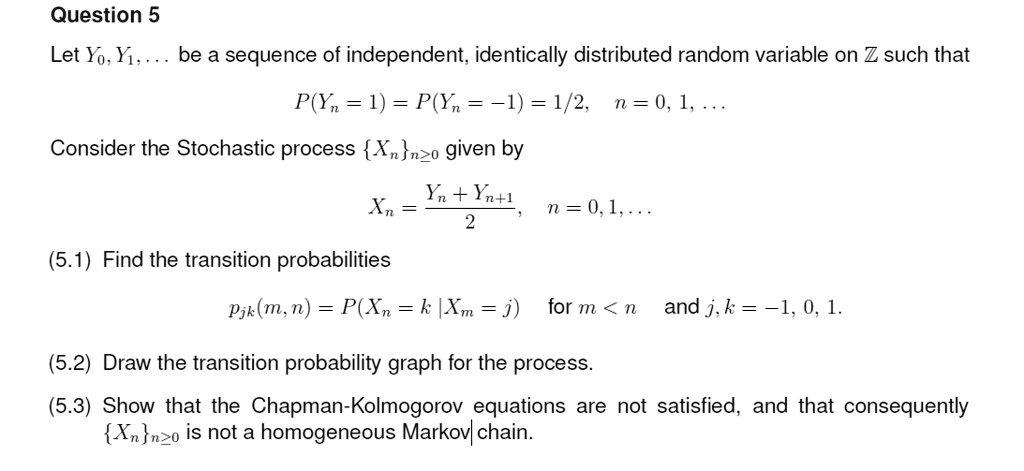
Question 5 Let $Y_0, Y_1,...$ be a sequence of independent, identically distributed random variable on $Z$ such that $P(Y_n = 1) = P(Y_n = -1) = 1/2$, $n = 0, 1, ...$ Consider the Stochastic process {$X_n$}$_{n \ge 0}$ given by $X_n = \frac{Y_n + Y_{n+1}}{2}$, $n = 0, 1, ...$ (5.1) Find the transition probabilities $p_{jk}(m, n) = P(X_n = k | X_m = j)$ for $m < n$ and $j, k = -1, 0, 1$. (5.2) Draw the transition probability graph for the process. (5.3) Show that the Chapman-Kolmogorov equations are not satisfied, and that consequently {$X_n$}$_{n \ge 0}$ is not a homogeneous Markov chain.
View Answer
divider