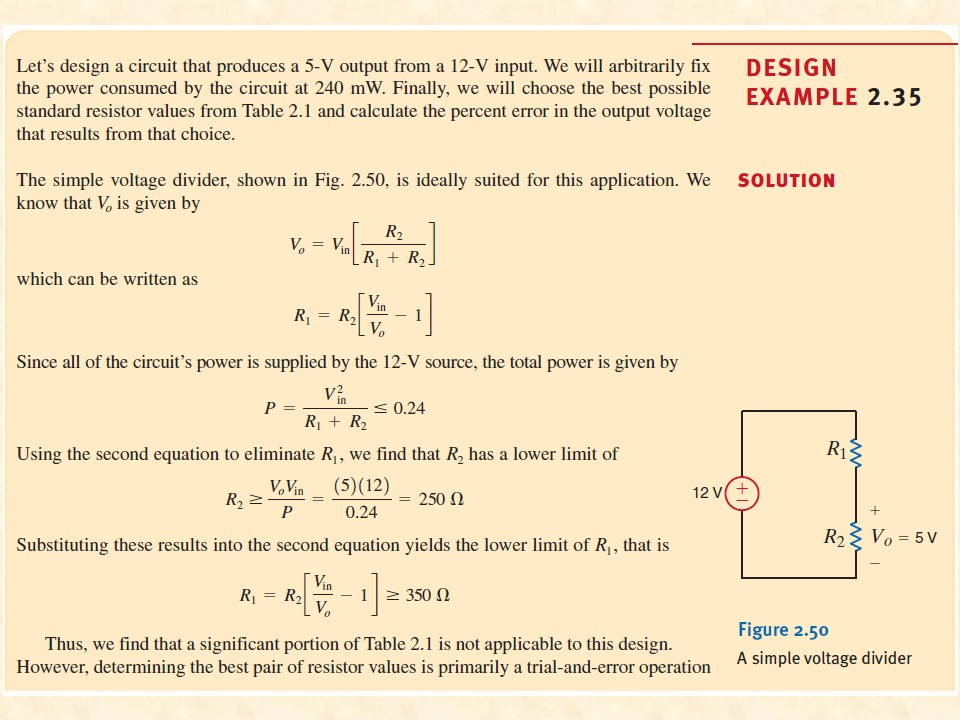
Let's design a circuit that produces a \( 5-\mathrm{V} \) output from a \( 12-\mathrm{V} \) input. We will arbitrarily fix the power consumed by the circuit at 240 mW . Finally, we will choose the best possible standard resistor values from Table 2.1 and calculate the percent error in the output voltage that results from that choice.
The simple voltage divider, shown in Fig. 2.50, is ideally suited for this application. We know that \( V_{o} \) is given by
\[
V_{o}=V_{\text {in }}\left[\frac{R_{2}}{R_{1}+R_{2}}\right]
\]
which can be written as
\[
R_{1}=R_{2}\left[\frac{V_{\text {in }}}{V_{o}}-1\right]
\]
Since all of the circuit's power is supplied by the \( 12-\mathrm{V} \) source, the total power is given by
\[
P=\frac{V_{\text {in }}^{2}}{R_{1}+R_{2}} \leq 0.24
\]
Using the second equation to eliminate \( R_{1} \), we find that \( R_{2} \) has a lower limit of
\[
R_{2} \geq \frac{V_{o} V_{\text {in }}}{P}=\frac{(5)(12)}{0.24}=250 \Omega
\]
Substituting these results into the second equation yields the lower limit of \( R_{1} \), that is
\[
R_{1}=R_{2}\left[\frac{V_{\mathrm{in}}}{V_{o}}-1\right] \geq 350 \Omega
\]
Thus, we find that a significant portion of Table 2.1 is not applicable to this design. However, determining the best pair of resistor values is primarily a trial-and-error operation
DESIGN EXAMPLE 2.35
SOLUTION