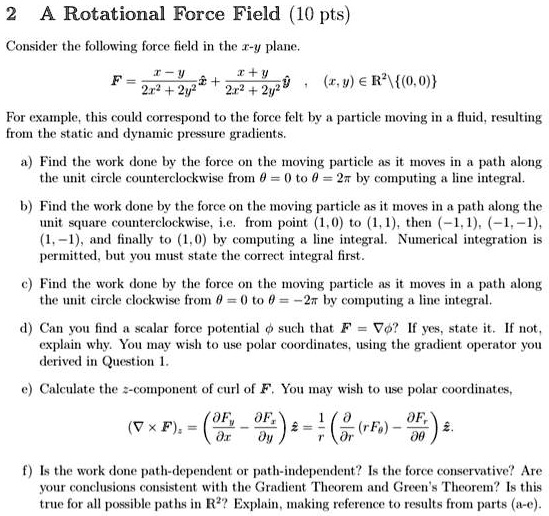
Texts: A Rotational Force Field (10 pts)
Consider the following force field in the x-y plane.
F = 2x^2 + 2y^2
For example, this could correspond to the force felt by a particle moving in a fluid, resulting from the static and dynamic pressure gradients.
a) Find the work done by the force on the moving particle as it moves in a path along the unit circle counterclockwise from θ = 0 to θ = 2π by computing a line integral.
b) Find the work done by the force on the moving particle as it moves in a path along the unit square counterclockwise, i.e. from point (1,0) to (1,1), then (-1,1) to (-1,-1), then (-1,-1) to (1,-1), and finally to (1,0) by computing a line integral. Numerical integration is permitted, but you must state the correct integral first.
c) Find the work done by the force on the moving particle as it moves in a path along the unit circle clockwise from θ = 0 to θ = -2π by computing a line integral.
d) Can you find a scalar force potential V such that F = ∇V? If yes, state it. If not, explain why. You may wish to use polar coordinates, using the gradient operator you derived in Question 1.
e) Calculate the z-component of curl of F. You may wish to use polar coordinates.
f) Is the work done path-dependent or path-independent? Is the force conservative? Are your conclusions consistent with the Gradient Theorem and Green's Theorem? Is this true for all possible paths in R^2? Explain, making reference to results from parts (a-e).