NYC COLLEGE OF TECHNOLOGY
PROFESSOR SUELA BEQIRI
MACROECONOMICS
FALL 2016
Student's Name,
Final Exam
45 questions-2 points each
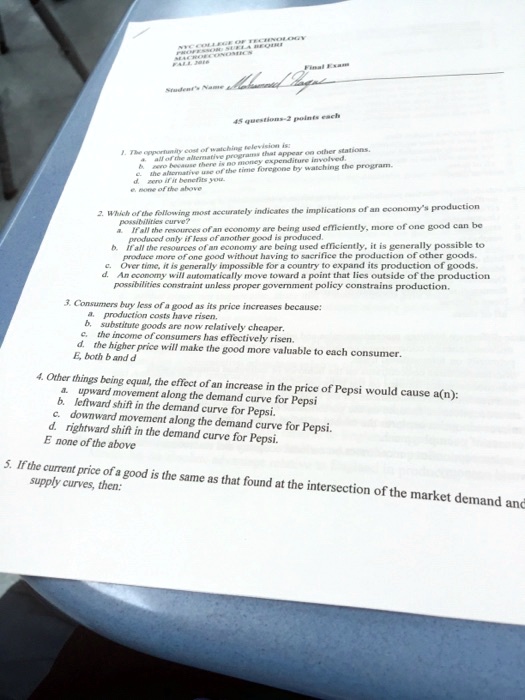
1. The opportunity cost of watching television is:
a. all of the alternative programs that appear on other stations.
b. zero because there is no money expenditure involved.
c. the alternative use of the time foregone by watching the program.
d. zero if it benefits you.
e. none of the above
2. Which of the following most accurately indicates the implications of an economy's production
possibilities curve?
a. If all the resources of an economy are being used efficiently, more of one good can be
produced only if less of another good is produced.
b. If all the resources of an economy are being used efficiently, it is generally possible to
produce more of one good without having to sacrifice the production of other goods.
c. Over time, it is generally impossible for a country to expand its production of goods.
d. An economy will automatically move toward a point that lies outside of the production
possibilities constraint unless proper government policy constrains production.
3. Consumers buy less of a good as its price increases because:
a. production costs have risen.
b. substitute goods are now relatively cheaper.
c. the income of consumers has effectively risen.
d. the higher price will make the good more valuable to each consumer.
E, both b and d
4. Other things being equal, the effect of an increase in the price of Pepsi would cause a(n):
a. upward movement along the demand curve for Pepsi
b. leftward shift in the demand curve for Pepsi.
c. downward movement along the demand curve for Pepsi.
d. rightward shift in the demand curve for Pepsi.
E none of the above
5. If the current price of a good is the same as that found at the intersection of the market demand and
supply curves, then: