6.1
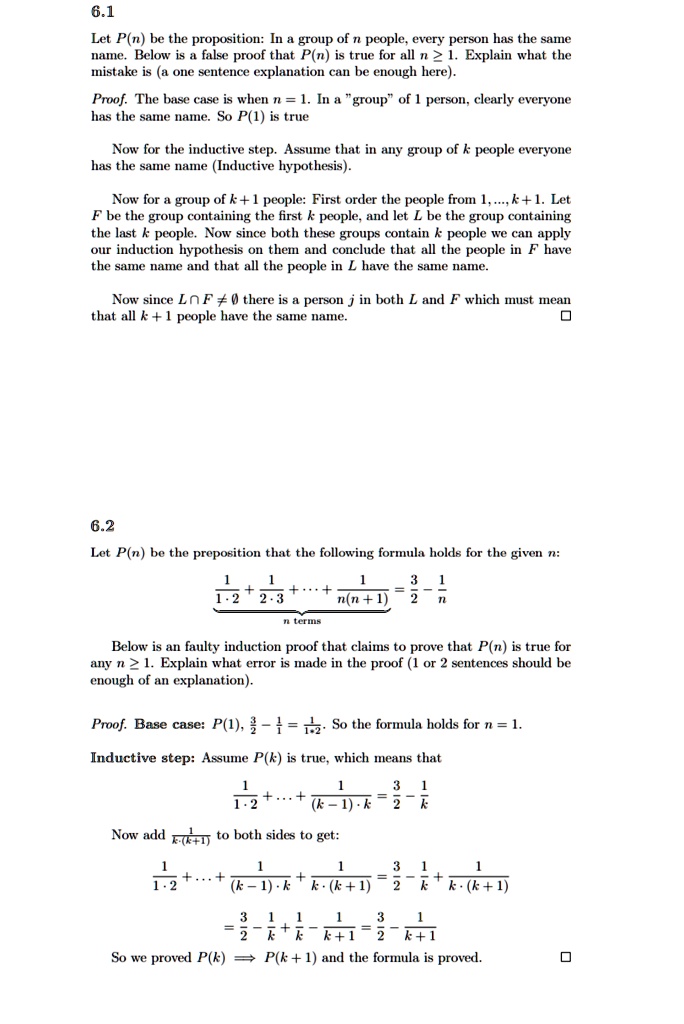
Let P(n) be the proposition: In a group of n people, every person has the same
name. Below is a false proof that P(n) is true for all n>=1. Explain what the
mistake is (a one sentence explanation can be enough here).
Proof. The base case is when n=1. In a "group" of 1 person, clearly everyone
has the same name. So P(1) is true
Now for the inductive step. Assume that in any group of k people everyone
has the same name (Inductive hypothesis).
Now for a group of k+1 people: First order the people from 1,...,k+1. Let
F be the group containing the first k people, and let L be the group containing
the last k people. Now since both these groups contain k people we can apply
our induction hypothesis on them and conclude that all the people in F have
the same name and that all the people in L have the same name.
Now since Lcap F!=Ø there is a person j in both L and F which must mean
that all k+1 people have the same name.
6.2
Let P(n) be the preposition that the following formula holds for the given n :
((1)/(1*2)+(1)/(2*3)+.....+(1)/(n(n+1)))=(3)/(2)-(1)/(n)
Below is an faulty induction proof that claims to prove that P(n) is true for
any n>=1. Explain what error is made in the proof ( 1 or 2 sentences should be
enough of an explanation).
Proof. Base case: P(1),(3)/(2)-(1)/(1)=(1)/(1*2). So the formula holds for n=1.
Inductive step: Assume P(k) is true, which means that
(1)/(1*2)+....+(1)/((k-1)*k)=(3)/(2)-(1)/(k)
Now add (1)/(k*(k+1)) to both sides to get:
(1)/(1*2)+....+(1)/((k-1)*k)+(1)/(k*(k+1))=(3)/(2)-(1)/(k)+(1)/(k*(k+1))
=(3)/(2)-(1)/(k)+(1)/(k)-(1)/(k+1)=(3)/(2)-(1)/(k+1)
So we proved P(k) --> P(k+1) and the formula is proved.
6.1
Let P(n) be the proposition: In a group of n people, every person has the same name. Below is a false proof that P(n) is true for all n 1. Explain what the mistake is (a one sentence explanation can be enough here).
Proof. The base case is when n = 1. In a group of 1 person, clearly everyone has the same name. So P(1) is true
Now for the inductive step. Assume that in any group of k people everyone has the same name (Inductive hypothesis).
Now for a group of k +1 people: First order the people from 1,, k +1. Let F be the group containing the first k people, and let L be the group containing the last k people. Now since both these groups contain k people we can apply our induction hypothesis on them and conclude that all the people in F have the same name and that all the people in L have the same name.
Now since L F there is a person j in both L and F which must mean that all k + 1 people have the same name.
6.2
Let P(n) be the preposition that the following formula holds for the given n:
1
1
31 1.22.3 n(n+1) 2n n terms
Below is an faulty induction proof that claims to prove that P(n) is true for any n 1. Explain what error is made in the proof (1 or 2 sentences should be enough of an explanation).
Proof. Base case: P(1), =. So the formula holds for n = 1.
Inductive step: Assume P(k) is true, which means that
1
1
Now add .-(k+1) to both sides to get:
1
1
1
3 1
1
31.1
1
3
1
So we proved Pk)= P(k+1 and the formula is proved