Consider any undirected graph G where the set of nodes is N = {1,2,3,...n} and the set of edges
is E = {1, 2, 3, ..., m}. A matching is simply a subset M of the edge set & with the property that
no two edges in M share a node. The cardinality of a matching is defined as the number of edges
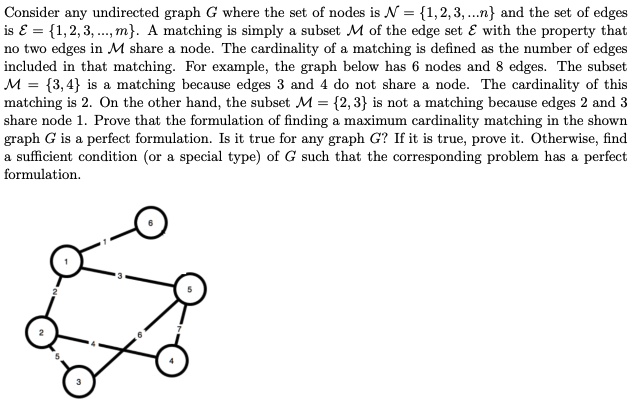
included in that matching. For example, the graph below has 6 nodes and 8 edges. The subset
M = {3,4} is a matching because edges 3 and 4 do not share a node. The cardinality of this
matching is 2. On the other hand, the subset M = {2,3} is not a matching because edges 2 and 3
share node 1. Prove that the formulation of finding a maximum cardinality matching in the shown
graph G is a perfect formulation. Is it true for any graph G? If it is true, prove it. Otherwise, find
a sufficient condition (or a special type) of G such that the corresponding problem has a perfect
formulation.