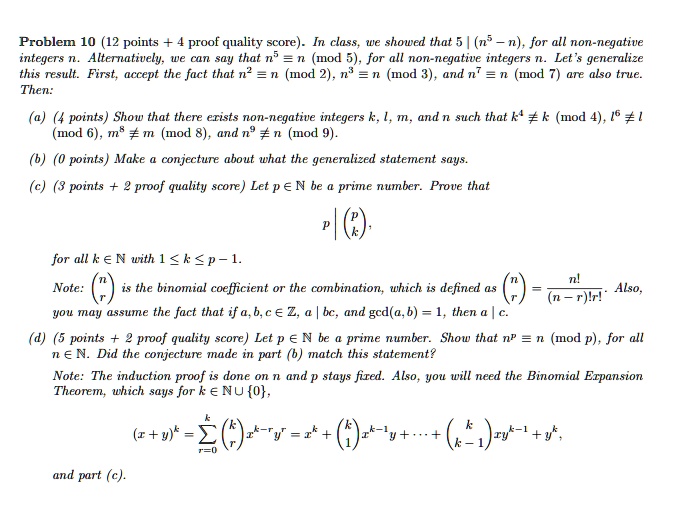
Problem 10 (12 points + 4 proof quality score). In class, we showed that 5 | (n⁵ - n), for all non-negative
integers n. Alternatively, we can say that n⁵ = n (mod 5), for all non-negative integers n. Let's generalize
this result. First, accept the fact that n² = n (mod 2), n³ = n (mod 3), and n⁷ = n (mod 7) are also true.
Then:
(a) (4 points) Show that there exists non-negative integers k, l, m, and n such that k⁴ ≠ k (mod 4), l⁶ ≠ 1
(mod 6), m³ ≠ m (mod 8), and n⁹ ≠ n (mod 9).
(b) (0 points) Make a conjecture about what the generalized statement says.
(c) (3 points + 2 proof quality score) Let p∈ N be a prime number. Prove that
$$p | \binom{p}{k},$$
for all k ∈ N with 1≤ k ≤p-1.
Note:
$$\binom{n}{r}$$
is the binomial coefficient or the combination, which is defined as
$$\binom{n}{r} = \frac{n!}{(n-r)!r!}.$$
Also,
you may assume the fact that if a, b, c ∈ Z, a | bc, and gcd(a,b) = 1, then a | c.
(d) (5 points + 2 proof quality score) Let p∈ N be a prime number. Show that nᵖ = n (mod p), for all
n∈ N. Did the conjecture made in part (b) match this statement?
Note: The induction proof is done on n and p stays fixed. Also, you will need the Binomial Expansion
Theorem, which says for k∈ NU {0},
$$(x + y)^k = \sum_{r=0}^k \binom{k}{r} x^{k-r}y^r = x^k + \binom{k}{1} x^{k-1}y + ... + \binom{k}{k-1} xy^{k-1} + y^k,$$
and part (c).