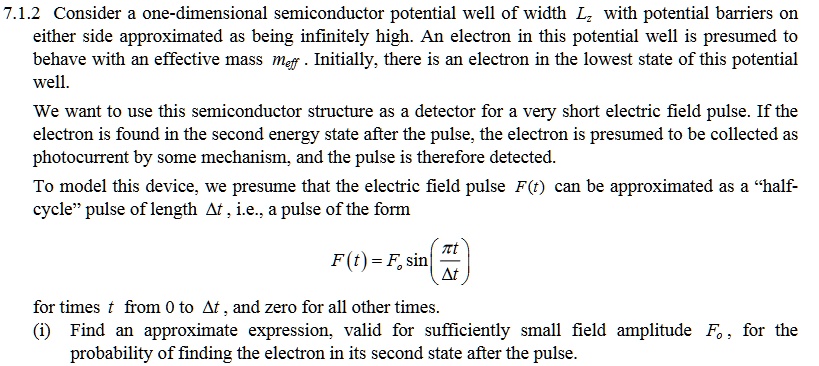
7.1.2 Consider a one-dimensional semiconductor potential well of width $L_z$ with potential barriers on either side approximated as being infinitely high. An electron in this potential well is presumed to behave with an effective mass $m_{eff}$. Initially, there is an electron in the lowest state of this potential well.
We want to use this semiconductor structure as a detector for a very short electric field pulse. If the electron is found in the second energy state after the pulse, the electron is presumed to be collected as photocurrent by some mechanism, and the pulse is therefore detected.
To model this device, we presume that the electric field pulse $F(t)$ can be approximated as a "half-cycle" pulse of length $\Delta t$, i.e., a pulse of the form
$$F(t) = F_0 \sin\left(\frac{\pi t}{\Delta t}\right)$$
for times $t$ from 0 to $\Delta t$, and zero for all other times.
(i) Find an approximate expression, valid for sufficiently small field amplitude $F_0$, for the probability of finding the electron in its second state after the pulse.