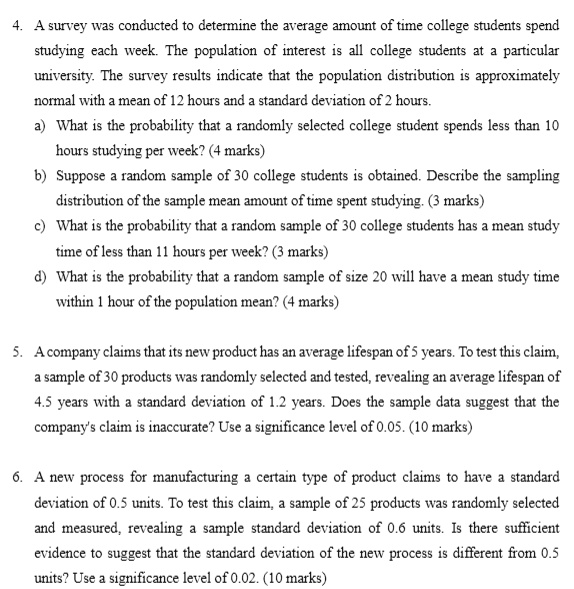
4. A survey was conducted to determine the average amount of time college students spend
studying each week. The population of interest is all college students at a particular
university. The survey results indicate that the population distribution is approximately
normal with a mean of 12 hours and a standard deviation of 2 hours.
a) What is the probability that a randomly selected college student spends less than 10
hours studying per week? (4 marks)
b) Suppose a random sample of 30 college students is obtained. Describe the sampling
distribution of the sample mean amount of time spent studying. (3 marks)
c) What is the probability that a random sample of 30 college students has a mean study
time of less than 11 hours per week? (3 marks)
d) What is the probability that a random sample of size 20 will have a mean study time
within 1 hour of the population mean? (4 marks)
5. A company claims that its new product has an average lifespan of 5 years. To test this claim,
a sample of 30 products was randomly selected and tested, revealing an average lifespan of
4.5 years with a standard deviation of 1.2 years. Does the sample data suggest that the
company's claim is inaccurate? Use a significance level of 0.05. (10 marks)
6. A new process for manufacturing a certain type of product claims to have a standard
deviation of 0.5 units. To test this claim, a sample of 25 products was randomly selected
and measured, revealing a sample standard deviation of 0.6 units. Is there sufficient
evidence to suggest that the standard deviation of the new process is different from 0.5
units? Use a significance level of 0.02. (10 marks)