Capacitance. Please solve these at an AP Physics C level.
Small correction. for Q2. part D, it should be multiplied by S
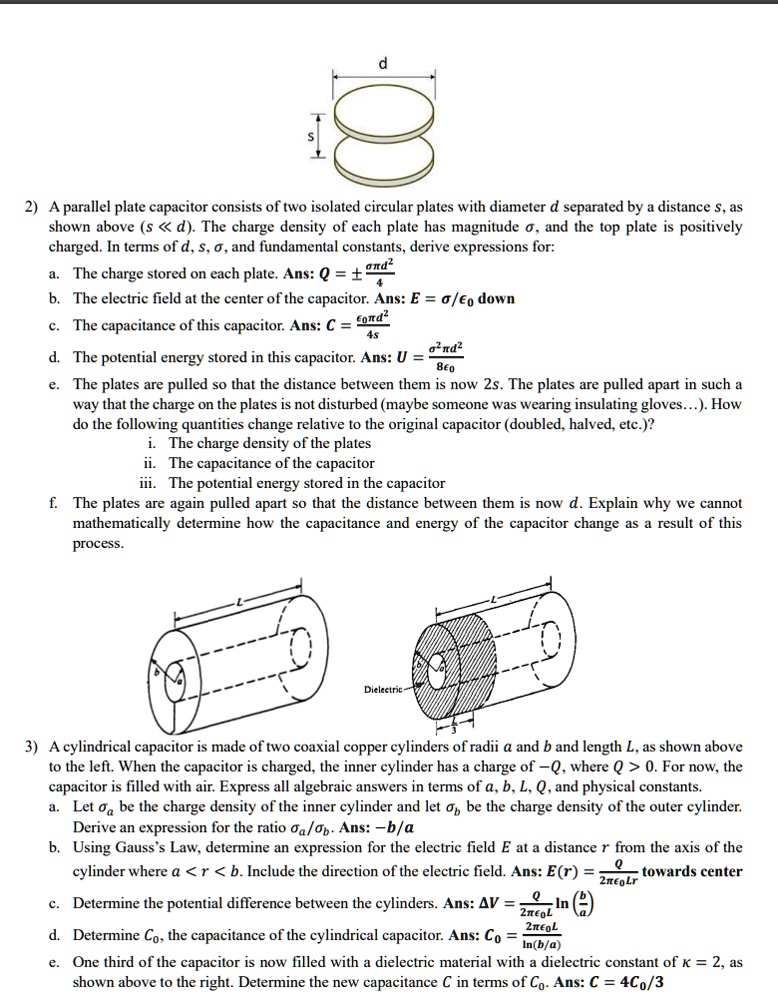
2) A parallel plate capacitor consists of two isolated circular plates with diameter d separated by a distance s, as shown above (s < d). The charge density of each plate has magnitude , and the top plate is positively charged. In terms of d, s, , and fundamental constants, derive expressions for:
b. The electric field at the center of the capacitor. Ans: E = /o down
4s
e. The plates are pulled so that the distance between them is now 2s. The plates are pulled apart in such a way that the following quantities change relative to the original capacitor (doubled, halved, etc.) i. The charge density of the plates ii. The capacitance of the capacitor iii. The potential energy stored in the capacitor
f. The plates are again pulled apart so that the distance between them is now d. Explain why we cannot mathematically determine how the capacitance and energy of the capacitor change as a result of this process.
Dielectric
3) A cylindrical capacitor is made of two coaxial copper cylinders of radii and b and length L, as shown above to the left. When the capacitor is charged, the inner cylinder has a charge of -Q, where Q > 0. For now, the capacitor is filled with air. Express all algebraic answers in terms of , b, L, Q, and physical constants. a. Let a be the charge density of the inner cylinder and let p be the charge density of the outer cylinder Derive an expression for the ratio a/p Ans: -b/ b. Using Gauss's Law, determine an expression for the electric field E at a distance r from the axis of the Q cylinder where <r< b. Include the direction of the electric field. Ans: E(r) = -towards center 2neoLr
2negL 2neoL In(b/a
e. One third of the capacitor is now filled with a dielectric material with a dielectric constant of K = 2, as shown above to the right. Determine the new capacitance C in terms of Co. Ans: C = 4Co/3