Questions asked
A ball is drawn randomly from a jar that contains 4 red balls, 2 white balls, and 7 yellow balls. Find the probability of the given event. Write your answers as reduced fractions or whole numbers. (a) P(A red ball is drawn) = (b) P(The ball drawn is NOT red) = (c) P(A green ball is drawn) =
Problem 1 (5 pts) Refer to the figure to the right for: Determine the tension developed in wires CA and CB required for equilibrium of the 6-kg cylinder. Take $\theta$ = 45° and use 40° instead of 30°. $F_{CA}$= $F_{CB}$ = Problem 2 (5 pts) Refer to the figure in problem 1 above for: If cable CB is subjected to a tension that is twice that of cable CA, determine the angle $\theta$ for equilibrium of the 6-kg cylinder. Also, what are the tensions in wires CA and CB? $\theta$= $F_{CA}$ = $F_{CB}$ =
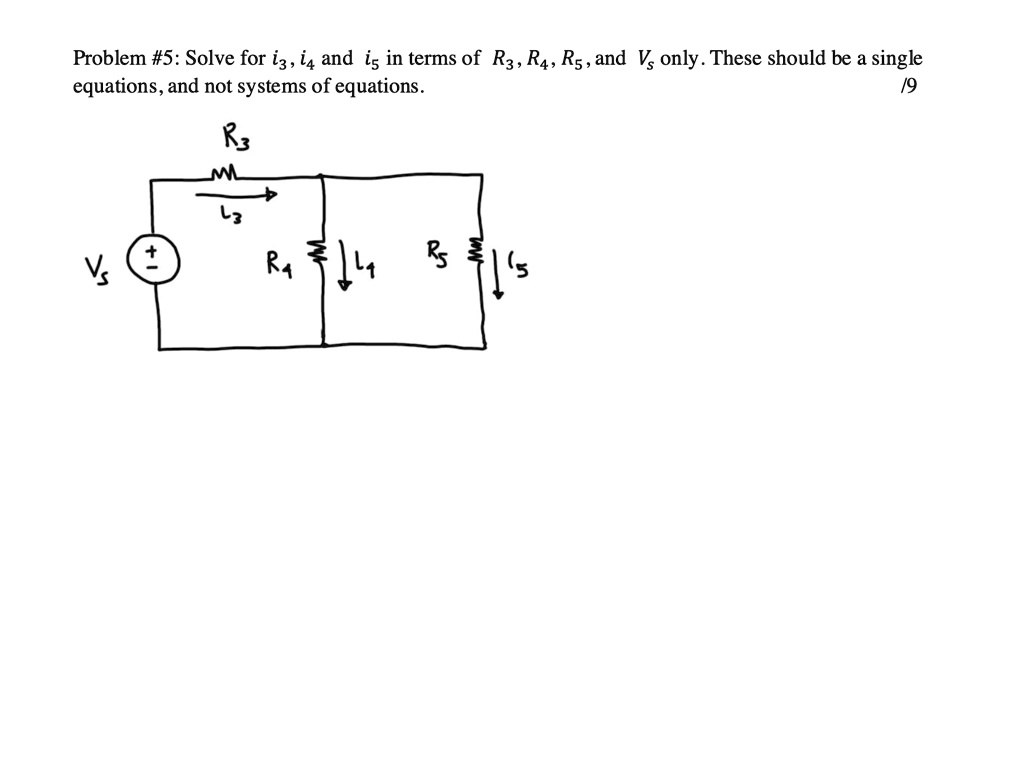
Problem #5: Solve for $i_3$, $i_4$ and $i_5$ in terms of $R_3$, $R_4$, $R_5$, and $V_s$ only. These should be a single equations, and not systems of equations.
For questions 2-3, refer to the following table: Diagnosed epilepsy epilepsy No epilepsy Present (Yes) 35 20 55 Absent (No) 53 82 135 2- The proportion of individuals with diagnosed epilepsy that present without a depressive disorder is approximately a- 0.6023 b- 0.3977 c- 0.1961 d- 0.8039
Find an equation of the line that passes through the point and has the indicated slope $m$. (Let $x$ be the independent variable and $y$ be the dependent variable.) $(1, 2)$; $m = -\frac{1}{2}$
The spring quail population in a national forest depends on the amount of feed placed throughout the forest during the preceding winter. A spring census finds that the population is $f(x) = \frac{2x+3}{x+2}$ in thousands of individuals when the feed is $x$ in hundreds of kg. • Plot $f(x)$ and $f'(x)$. • Find the average rate of change of the spring quail population between the feed 400 kg and 600 kg and give an interpretation. • Find the rate of change of the spring quail population when the feed is 400 kg.
1. What would be the calculations for a 22 y/o Male, 104 kg; 204 cm? (10 points) Adult Males REE=66.5+13.7 (Weight in kg)+5.0(Height in cm) -6.8(Age) REE = Activity Factor \times 1.2 for bed rest \times 1.3 for low activity \times 1.5 for average activity \times 1.75 for active \times 2.0 for intense active EXPENDITURE
17 28 29 28 Lateral Fissure 29 Temporal Lobe Identify the Brain Structure 21 22 20 19 23 16 11 15
10. Assume $t_{clk-q}$ is 0.6 ns, $t_{su}$ is 0.4 ns, and $t_{hold}$ is 0.5 ns. Calculate the minimum clock period (in ns) and the maximum clock frequency (in MHz) in the way that no clock skew exists and the maximum (or minimum) clock skews (in ns) to avoid race conditions.
Power system! Fall 2017 Quiz 2 Problem 1 (50 Points) Voltage drop across the brushes. The motor is connected as a long-shunt compound operation. Calculate: a) The shunt field current b) The armature current c) The input current d) The power produced by the motor e) The real power losses