Text: Electric field of a uniformly charged thin rod
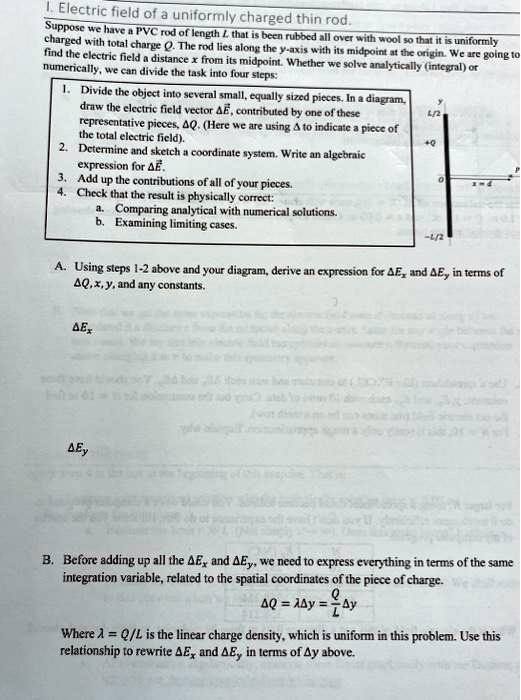
To examine the electric field of a uniformly charged thin rod numerically, we can divide the task into four steps:
1. Divide the object into several small, equally sized pieces. In a diagram, draw the electric field vector contributed by one of these representative pieces, denoted as Q. Here, we are using Q to indicate a piece of the total electric field.
2. Determine and sketch a coordinate system. Write an algebraic expression for Ey.
3. Add up the contributions of all of your pieces.
4. Check that the result is physically correct by comparing analytical with numerical solutions and examining limiting cases.
A. Using steps 1-2 above and your diagram, derive an expression for E and Ey in terms of Q, xy, and any constants.
E =
Ey =
B. Before adding up all the E and Ey, we need to express everything in terms of the same integration variable, related to the spatial coordinates of the piece of charge. Let Q = y = Ay, where A = Q/L is the linear charge density, which is uniform in this problem. Use this relationship to rewrite E and Ey in terms of y above.