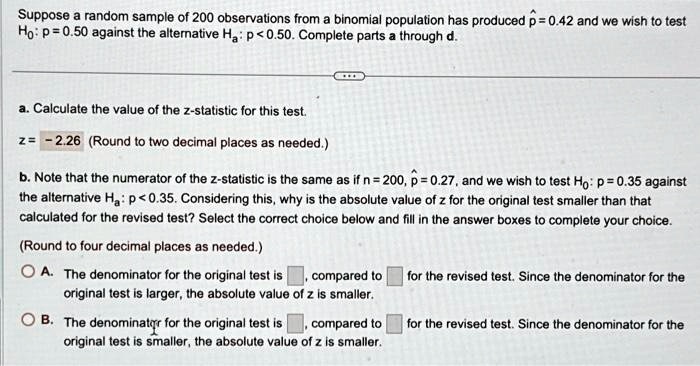
Suppose a random sample of 200 observations from a binomial population has produced \(\hat{p} = 0.42\) and we wish to test \(H_0: p = 0.50\) against the alternative \(H_a: p < 0.50\). Complete parts a through d.
a. Calculate the value of the z-statistic for this test.
\(z = -2.26\) (Round to two decimal places as needed.)
b. Note that the numerator of the z-statistic is the same as if \(n = 200\), \(\hat{p} = 0.27\), and we wish to test \(H_0: p = 0.35\) against the alternative \(H_a: p < 0.35\). Considering this, why is the absolute value of z for the original test smaller than that calculated for the revised test? Select the correct choice below and fill in the answer boxes to complete your choice.
(Round to four decimal places as needed.)
A. The denominator for the original test is , compared to for the revised test. Since the denominator for the original test is larger, the absolute value of z is smaller.
B. The denominator for the original test is compared to for the revised test. Since the denominator for the original test is smaller, the absolute value of z is smaller.