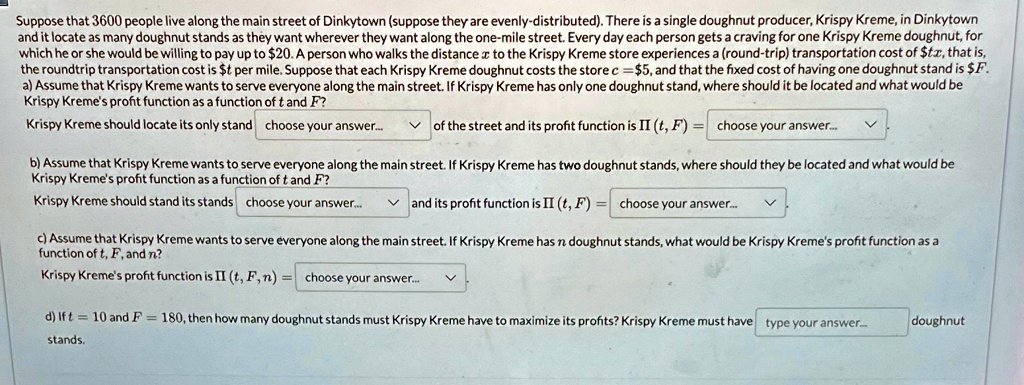
Suppose that 3600 people live along the main street of Dinkytown (suppose they are evenly distributed). There is a single doughnut producer, Krispy Kreme, in Dinkytown and it can locate as many doughnut stands as they want wherever they want along the one-mile street. Every day each person gets a craving for one Krispy Kreme doughnut, for which he or she would be willing to pay up to $20. A person who walks the distance x to the Krispy Kreme store experiences a (round-trip) transportation cost of $tx, that is, the roundtrip transportation cost is $t per mile. Suppose that each Krispy Kreme doughnut costs the store c=$5, and that the fixed cost of having one doughnut stand is $F.
a) Assume that Krispy Kreme wants to serve everyone along the main street. If Krispy Kreme has only one doughnut stand, where should it be located and what would be Krispy Kreme's profit function as a function of t and F?
Krispy Kreme should locate its only stand on the street and its profit function is Π(t,F)=
b) Assume that Krispy Kreme wants to serve everyone along the main street. If Krispy Kreme has two doughnut stands, where should they be located and what would be Krispy Kreme's profit function as a function of t and F?
Krispy Kreme should stand its stands and its profit function is Π(t,F)=
c) Assume that Krispy Kreme wants to serve everyone along the main street. If Krispy Kreme has n doughnut stands, what would be Krispy Kreme's profit function as a function of t, F, and n?
Krispy Kreme's profit function is Π(t,F,n)=
d) If t=10 and F=180, then how many doughnut stands must Krispy Kreme have to maximize its profits? Krispy Kreme must have stands.