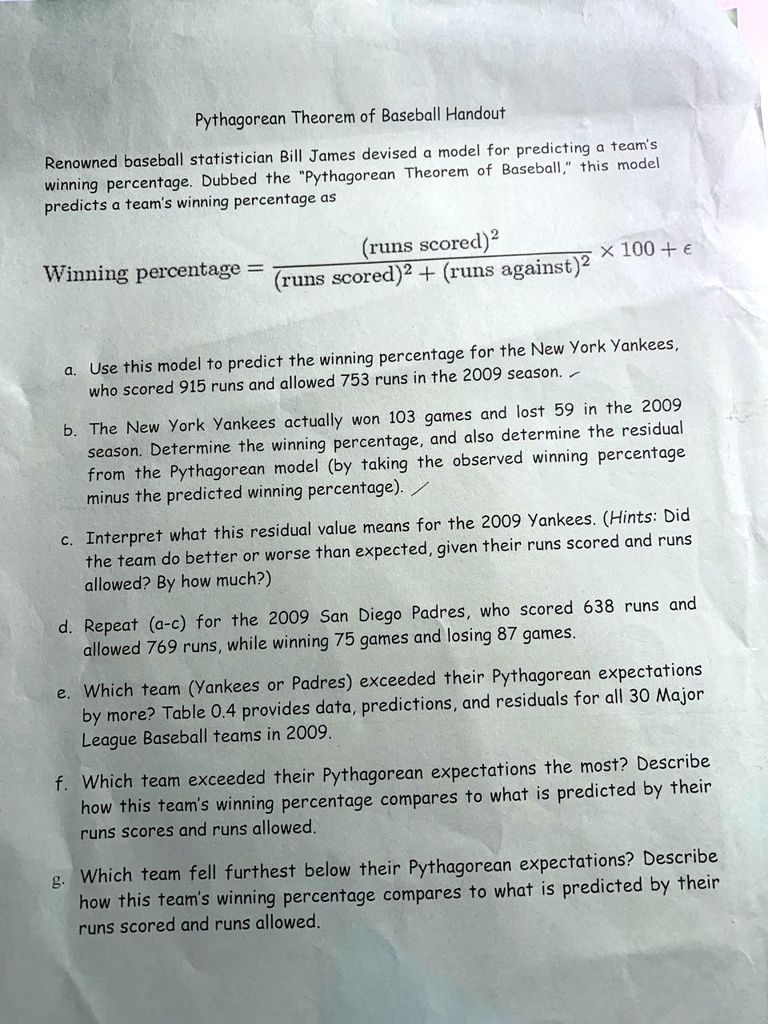
Pythagorean Theorem of Baseball Handout
Renowned baseball statistician Bill James devised a model for predicting a team's
winning percentage. Dubbed the \"Pythagorean Theorem of Baseball,\" this model
predicts a team's winning percentage as
Winning percentage = \frac{(runs\ scored)^2}{(runs\ scored)^2 + (runs\ against)^2} \times 100 + \epsilon
a. Use this model to predict the winning percentage for the New York Yankees,
who scored 915 runs and allowed 753 runs in the 2009 season.
b. The New York Yankees actually won 103 games and lost 59 in the 2009
season. Determine the winning percentage, and also determine the residual
from the Pythagorean model (by taking the observed winning percentage
minus the predicted winning percentage).
c. Interpret what this residual value means for the 2009 Yankees. (Hints: Did
the team do better or worse than expected, given their runs scored and runs
allowed? By how much?)
d. Repeat (a-c) for the 2009 San Diego Padres, who scored 638 runs and
allowed 769 runs, while winning 75 games and losing 87 games.
e. Which team (Yankees or Padres) exceeded their Pythagorean expectations
by more? Table 0.4 provides data, predictions, and residuals for all 30 Major
League Baseball teams in 2009.
f. Which team exceeded their Pythagorean expectations the most? Describe
how this team's winning percentage compares to what is predicted by their
runs scores and runs allowed.
g. Which team fell furthest below their Pythagorean expectations? Describe
how this team's winning percentage compares to what is predicted by their
runs scored and runs allowed.