A Case Study in Blood and Heart
An ambulance arrives at with a patient who appears to be a middle-aged male. The
patient states that she identifies as female, she is 48 years old, and her name is Tasha
Silvers. Tasha was just in a bad automobile accident in which the airbag deployed. She is
covered in blood and is only semi-lucid as she babbles on about pushing out the broken
glass in her car window.
The paramedics state that she was bleeding profusely from multiple left-arm cuts and an
especially deep laceration on her left upper arm. Paramedics state that they stopped the
bleeding and moved her quickly to the ambulance, after noting no other apparent injury.
Her systolic blood pressure is 80 mm Hg, and her diastolic is not audible. Her heart rate
is 122 bpm (very rapid), and her skin is pale and clammy, indicating peripheral
vasoconstriction (narrowing of her blood vessels, particularly in the skin) and circulatory
shock-like signs. On the way to the hospital, a paramedic begins transfusing normal
saline solution (NSS; water with some NaCl, similar to body fluids, given directly into
her vein). Two liters of NSS are transfused over the next hour while the ED physician
sutures her deepest, left-upper-arm laceration. She is admitted to the hospital for
overnight observation.
A fast hematocrit (HCT) test was done on Tasha upon arrival to the emergency
department (ED) and indicates that her HCT is very low. Several vials of Tasha's blood
are also sent to the lab for blood tests. The blood tests include blood typing, complete
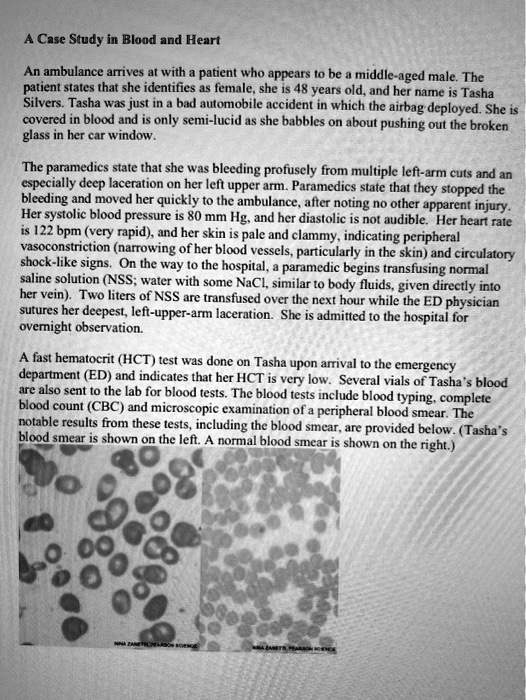
blood count (CBC) and microscopic examination of a peripheral blood smear. The
notable results from these tests, including the blood smear, are provided below. (Tasha's
blood smear is shown on the left. A normal blood smear is shown on the right.)