Ace - AI Tutor
Ask Our Educators
Textbooks
My Library
Flashcards
Scribe - AI Notes
Notes & Exams
Download App
natalia hernandez

natalia h.

Divider

Questions asked

BEST MATCH

An individual with one recessive allele and one allele has a heterozygous genotype.

View Answer
divider
BEST MATCH

(2 pts) How much capital and labor will Miguel and Jake need to rent and hire in order to produce 1,000 reams of paper each week? How much will hiring these inputs cost them?

View Answer
divider
BEST MATCH

.Part B.5. A “little more” than 5 mL of a saturated solution is transferred to the corresponding calibrated test tube and subsequently titrated with the standardized hydrochloric acid solution. How will this “generosity” affect the reported molar solubility of borax for that sample—too high, too low, or unaffected? Explain.

View Answer
divider
BEST MATCH

Babies benefit from a great deal of stimulation: different textures to feel, shapes and colors to look at, and various sounds to hear.

View Answer
divider
BEST MATCH

Explain how the seminiferous tubules differ from interstitial cells in terms of the hormones that act on each structure and what they, in turn, produce.

View Answer
divider
BEST MATCH

The risk that there will a change in interest or market prices is

View Answer
divider
BEST MATCH

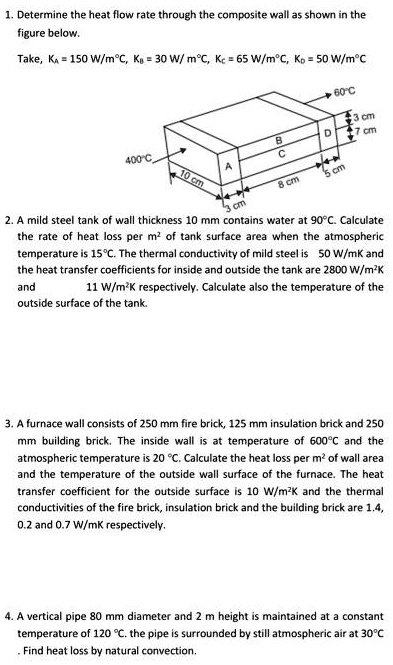
1. Determine the heat flow rate through the composite wall as shown in the figure below. Take, $K_A$ = 150 W/m°C, $K_B$ = 30 W/m°C, $K_C$ = 65 W/m°C, $K_D$ = 50 W/m°C 400°C 10 cm 60°C 3 cm B C D 7 cm A 8 cm 3 cm 5 cm 2. A mild steel tank of wall thickness 10 mm contains water at 90°C. Calculate the rate of heat loss per m² of tank surface area when the atmospheric temperature is 15°C. The thermal conductivity of mild steel is 50 W/mK and the heat transfer coefficients for inside and outside the tank are 2800 W/m²K and 11 W/m²K respectively. Calculate also the temperature of the outside surface of the tank. 3. A furnace wall consists of 250 mm fire brick, 125 mm insulation brick and 250 mm building brick. The inside wall is at temperature of 600°C and the atmospheric temperature is 20 °C. Calculate the heat loss per m² of wall area and the temperature of the outside wall surface of the furnace. The heat transfer coefficient for the outside surface is 10 W/m²K and the thermal conductivities of the fire brick, insulation brick and the building brick are 1.4, 0.2 and 0.7 W/mK respectively. 4. A vertical pipe 80 mm diameter and 2 m height is maintained at a constant temperature of 120 °C. the pipe is surrounded by still atmospheric air at 30°C . Find heat loss by natural convection.
View Answer
divider
BEST MATCH

Texts: Consider a process, where a flow steam of 2 kg/s completely dry air at T1 temperature and 100 kPa pressure is brought at 30 degrees Celsius by spraying liquid water at the temperature of 30 degrees Celsius, and pressure 100 kPa into it so that it becomes saturated air at 30 degrees Celsius (at the exit). Assuming no other heat or work transfer to the system, find the following: a) Inlet temperature, T1 of dry air b) Humidity ratio of exit mist air c) Flow rate of liquid water d) Represent how the process will appear in a psychrometric chart

View Answer
divider
BEST MATCH

Part 1 of 2 Points: 0 of 1 Find the present value and the compound discount of $2704.17 due 4 years from now if money is worth 2% compounded quarterly. The present value of the money is $ (Round to the nearest cent as needed. Round all intermediate values to six decimal places as needed.)

View Answer
divider
BEST MATCH

Problem 6: Up through history, great minds have developed different computational schemes for the number $\pi$. We will here consider two such schemes, one by Leibniz (1646- 1716), and one by Euler (1707-1783). The scheme by Leibniz may be written $\pi = 8 \sum_{k=0}^{\infty} \frac{1}{(4k+1)(4k+3)}$, while one form of the Euler scheme may appear as $\pi = \sqrt{6 \sum_{k=1}^{\infty} \frac{1}{k^2}}$. If only the first $N$ terms of each sum are used as an approximation to $\pi$, each modified scheme will have computed $\pi$ with some error. Write a program that takes $N$ as input from the user, and plots the error develop- ment with both schemes as the number of iterations approaches $N$. Your program should also print out the final error achieved with both schemes, i.e. when the num- ber of terms is $N$. Run the program with $N = 100$ and explain briefly what the graphs show.

View Answer
divider