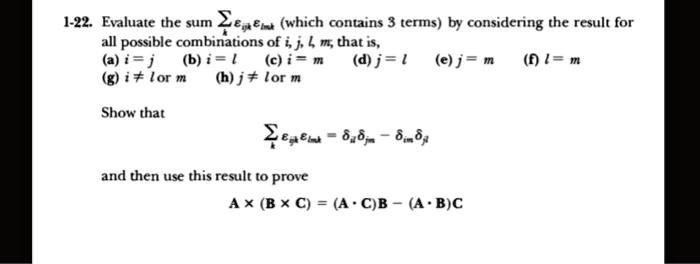
1-22. Evaluate the sum $\sum_k \epsilon_{ijk}\epsilon_{lmk}$ (which contains 3 terms) by considering the result for all possible combinations of $i, j, l, m$, that is,
(a) $i = j$
(g) $i \neq l$ or $m$
Show that
(b) $i = l$
(h) $j \neq l$ or $m$
(c) $i = m$
(d) $j = l$
(e) $j = m$
(f) $l = m$
$\sum_k \epsilon_{ijk}\epsilon_{lmk} = \delta_{il}\delta_{jm} - \delta_{im}\delta_{jl}$
and then use this result to prove
$\mathbf{A} \times (\mathbf{B} \times \mathbf{C}) = (\mathbf{A} \cdot \mathbf{C})\mathbf{B} - (\mathbf{A} \cdot \mathbf{B})\mathbf{C}$