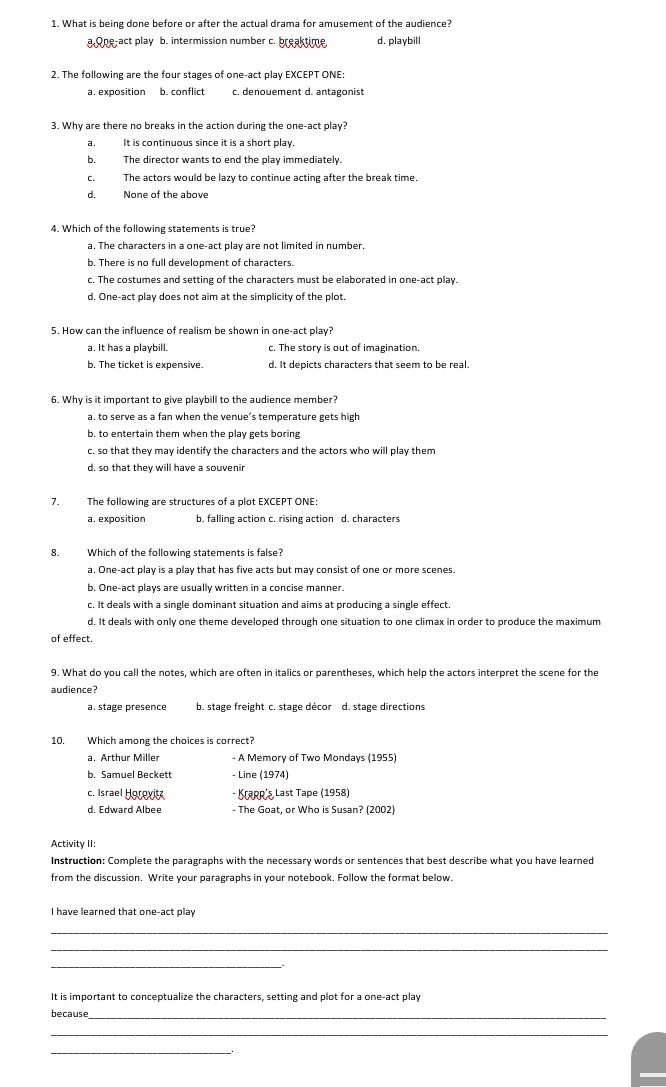
1. What is being done before or after the actual drama for amusement of the audience?
adee-act play b. intermission number c. breaktime
d. playbill
2. The following are the four stages of one-act play EXCEPT ONE:
a. exposition
b. conflict
c. denouement \( d \). antagonist
3. Why are there no breaks in the action during the one-act play?
a. It is continuous since it is a short play.
b. The director wants to end the play immediately.
c. The actors would be lazy to continue acting after the break time.
d. None of the above
4. Which of the following statements is true?
a. The characters in a one-act play are not limited in number.
b. There is no full development of characters.
c. The costumes and setting of the characters must be elaborated in one-act play.
d. One-act play does not aim at the simplicity of the plot.
5. How can the influence of realism be shown in one-act play?
a. It has a playbill.
c. The story is out of imagination.
b. The ticket is expensive.
d. It depicts characters that seem to be real.
6. Why is it important to give playbill to the audience member?
a. to serve as a fan when the venue's temperature gets high
b. to entertain them when the play gets boring
c. so that they may identify the characters and the actors who will play them
d. so that they will have a souvenir
7. The following are structures of a plot EXCEPT ONE:
a. exposition
b. falling action c. rising action
d. characters
8. Which of the following statements is false?
a. One-act play is a play that has five acts but may consist of one or more scenes.
b. One-act plays are usually written in a concise manner.
c. It deals with a single dominant situation and aims at producing a single effect.
d. It deals with only one theme developed through one situation to one climax in order to produce the maximum of effect.
9. What do you call the notes, which are often in italics or parentheses, which help the actors interpret the scene for the audience?
a. stage presence
b. stage freight \( c \). stage décor
d. stage directions
10. Which among the choices is correct?
a. Arthur Miller
- A Memory of Two Mondays (1955)
b. Samuel Beckett
- Line (1974)
c. Israel Hereyitz
- KrapR's Last Tape (1958)
d. Edward Albee
- The Goat, or Who is Susan? (2002)
Activity II:
Instruction: Complete the paragraphs with the necessary words or sentences that best describe what you have learned from the discussion. Write your paragraphs in your notebook. Follow the format below.
I have learned that one-act play
\( \qquad \)
\( \qquad \)
\( \qquad \)
It is important to conceptualize the characters, setting and plot for a one-act play because \( \qquad \)
\( \qquad \)
\( \qquad \)