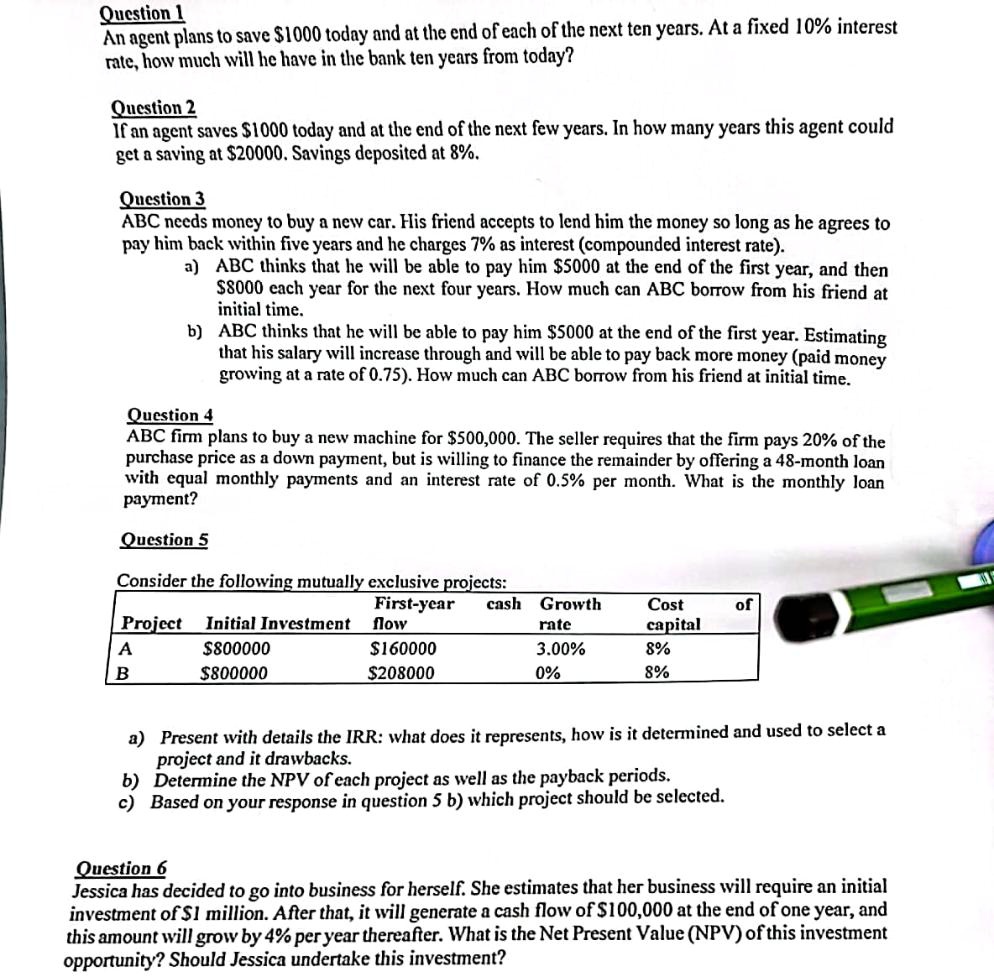
Question 1: An agent plans to save $1000 today and at the end of each of the next ten years. At a fixed 10% interest rate, how much will he have in the bank ten years from today?
Question 2: If an agent saves $1000 today and at the end of the next few years, in how many years could this agent save $20000? Savings are deposited at 8%.
Question 3: ABC needs money to buy a new car. His friend agrees to lend him the money as long as he agrees to pay him back within five years and charges 7% interest (compounded interest rate).
a) ABC plans to pay him $5000 at the end of the first year, and then $8000 each year for the next four years. How much can ABC borrow from his friend initially?
b) If the interest rate is growing at a rate of 0.75%, how much can ABC borrow from his friend initially?
Question 4: ABC firm plans to buy a new machine for $500,000. The seller requires that the firm pays 20% of the purchase price as a down payment, but is willing to finance the remainder by offering a 48-month loan with equal monthly payments and an interest rate of 0.5% per month. What is the monthly loan payment?
Question 5: Consider the following mutually exclusive projects:
Project A: Initial Investment - $800,000, First-year cash flow - $160,000, Growth rate - 3.00%, Cost of capital - 8%
Project B: Initial Investment - $800,000, First-year cash flow - $208,000, Growth rate - 0%, Cost of capital - 8%
a) Determine the NPV of each project as well as the payback periods.
b) Based on your response in question 5b, which project should be selected?
Question 6: Jessica has decided to go into business for herself. She estimates that her business will require an initial investment of $1 million. After that, it will generate a cash flow of $100,000 at the end of one year, and this amount will grow by 4% per year thereafter. What is the Net Present Value (NPV) of this investment opportunity? Should Jessica undertake this investment?