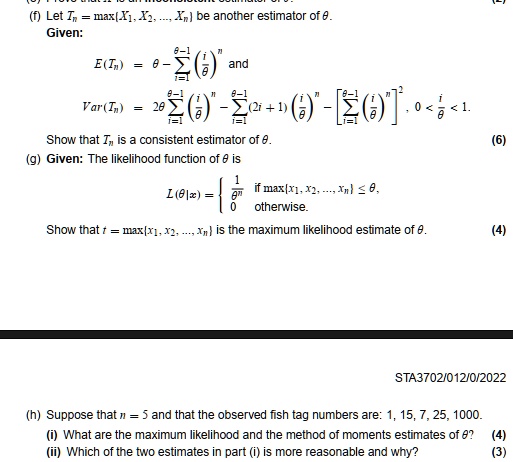
(f) Let $T_n = \text{max}(X_1, X_2, ..., X_n)$ be another estimator of $\theta$.
Given:
$\mathbb{E}(T_n) = \theta - \sum_{i=1}^{\theta - 1} i \left(\frac{i}{\theta}\right)^n$ and
$\text{Var}(T_n) = 2\theta \sum_{i=1}^{\theta - 1} \left(\frac{i}{\theta}\right)^n - \sum_{i=1}^{\theta - 1} (2i + 1) \left(\frac{i}{\theta}\right)^n - \left[\sum_{i=1}^{\theta - 1} \left(\frac{i}{\theta}\right)^n\right]^2$, $0 < \frac{i}{\theta} < 1$.
Show that $T_n$ is a consistent estimator of $\theta$.
(g) Given: The likelihood function of $\theta$ is
$L(\theta|x) = \begin{cases} \frac{1}{\theta^n} & \text{if } \text{max}(x_1, x_2, ..., x_n) \le \theta, \\\ 0 & \text{otherwise.} \end{cases}$
Show that $t = \text{max}(X_1, X_2, ..., X_n)$ is the maximum likelihood estimate of $\theta$.
(h) Suppose that $n = 5$ and that the observed fish tag numbers are: 1, 15, 7, 25, 1000.
(i) What are the maximum likelihood and the method of moments estimates of $\theta$?
(ii) Which of the two estimates in part (i) is more reasonable and why?