Ace - AI Tutor
Ask Our Educators
Textbooks
My Library
Flashcards
Scribe - AI Notes
Notes & Exams
Download App
Jan Ann

Jan A.

Divider

Questions asked

ANSWERED

Zhumagali Shomanov verified

Numerade educator

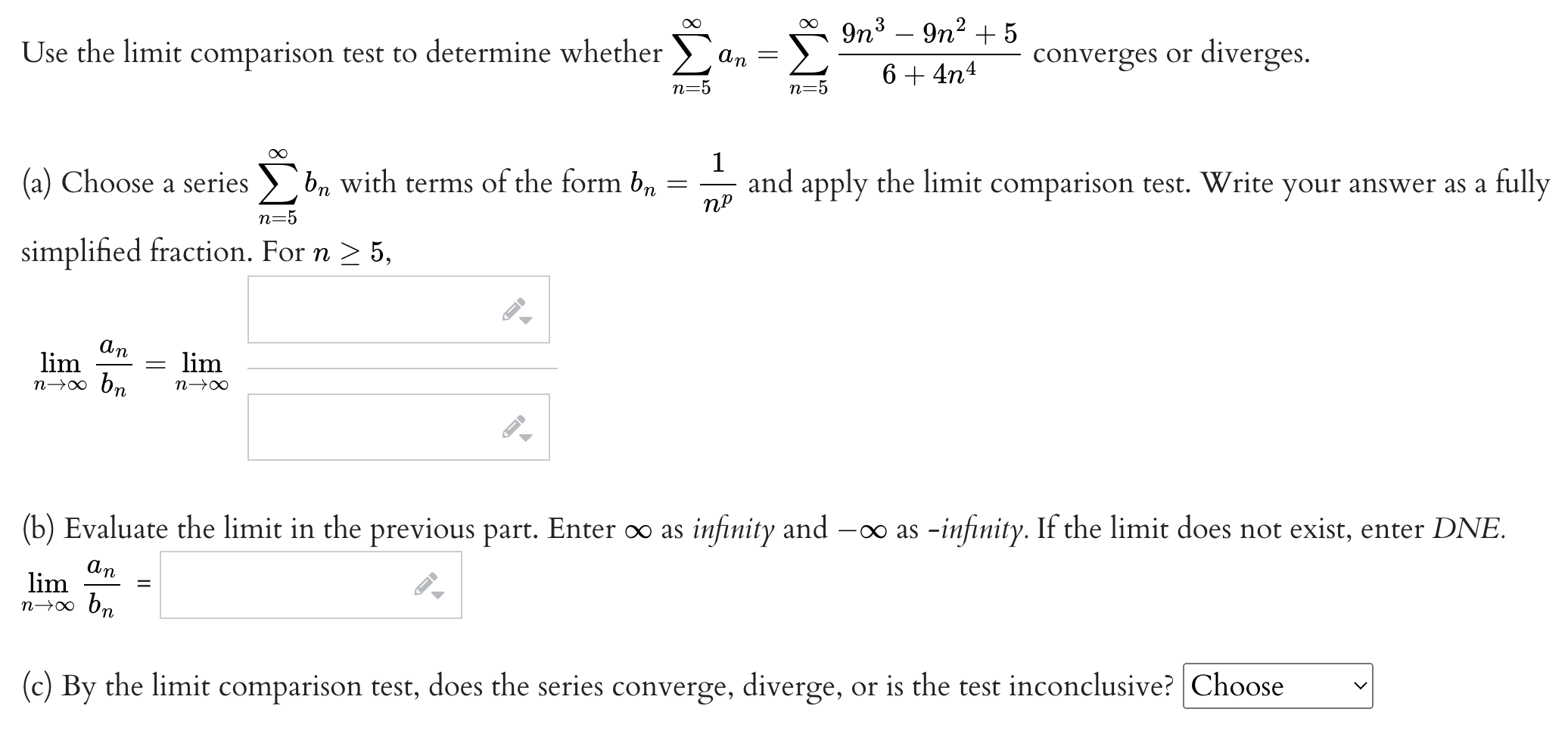
Use the limit comparison test to determine whether ( sum_{n=5}^{infty} a_{n}=sum_{n=5}^{infty} frac{9 n^{3}-9 n^{2}+5}{6+4 n^{4}} ) converges or diverges. (a) Choose a series ( sum_{n=5}^{infty} b_{n} ) with terms of the form ( b_{n}=frac{1}{n^{p}} ) and apply the limit comparison test. Write your answer as a fully simplified fraction. For ( n geq 5 ) [ lim _{n ightarrow infty} frac{a_{n}}{b_{n}}=lim _{n ightarrow infty} ] (b) Evaluate the limit in the previous part. Enter ( infty ) as infinity and ( -infty ) as -infinity. If the limit does not exist, enter DNE. ( lim _{n ightarrow infty} frac{a_{n}}{b_{n}}= ) (c) By the limit comparison test, does the series converge, diverge, or is the test inconclusive? Choose
View Answer
divider
ANSWERED

Zhumagali Shomanov verified

Numerade educator

Use the Comparison Test to determine whether the infinite series is convergent. [ sum_{n=1}^{infty} frac{sin ^{6} n}{n^{6}} ] By the Comparison Test, the infinite series ( sum_{n=1}^{infty} frac{sin ^{6} n}{n^{6}} ) A. converges B. diverges Note: You are allowed only one attempt on this problem.

View Answer
divider
ANSWERED

Zhumagali Shomanov verified

Numerade educator

Use the Comparison Test to determine whether the infinite series is convergent. [ sum_{n=2}^{infty} frac{n^{frac{28}{9}}}{n^{4}-n} ] By the Comparison Test, the infinite series ( sum_{n=2}^{infty} frac{n^{frac{28}{9}}}{n^{4}-n} ) A. converges B. diverges Note: You are allowed only one attempt on this problem.

View Answer
divider
ANSWERED

Zhumagali Shomanov verified

Numerade educator

Use the Integral Test to determine whether the infinite series is convergent. $$sum_{n=1}^{infty} frac{8}{8^{ln n}}$$ Fill in the corresponding integrand and the value of the improper integral. Enter inf for ?, -inf for -?, and DNE if the limit does not exist. Compare with $int_{1}^{infty} dx =$ By the Integral Test, the infinite series $sum_{n=1}^{infty} frac{8}{8^{ln n}}$ A. converges B. diverges

View Answer
divider
ANSWERED

Zhumagali Shomanov verified

Numerade educator

Use the Integral Test to determine whether the infinite series is convergent. ?_{n=4}^{?} 20ne^{-n^2} Fill in the corresponding integrand and the value of the improper integral. Enter inf for ?, -inf for -?, and DNE if the limit does not exist. Compare with ?_4^{?} dx = By the Integral Test, the infinite series ?_{n=4}^{?} 20ne^{-n^2} A. converges B. diverges

View Answer
divider
ANSWERED

Zhumagali Shomanov verified

Numerade educator

Use the Integral Test to determine whether the infinite series is convergent. $$sum_{n=1}^{infty} frac{1}{n^{2}+1}$$ Fill in the corresponding integrand and the value of the improper integral. Enter inf for ?, -inf for ??, and DNE if the limit does not exist. Compare with $int_{1}^{infty} dx =$ By the Integral Test, the infinite series $sum_{n=1}^{infty} frac{1}{n^{2}+1}$ A. converges B. diverges

View Answer
divider
ANSWERED

Zhumagali Shomanov verified

Numerade educator

Use the Integral Test to determine whether the infinite series is convergent. $$sum_{n=22}^{infty} frac{n^{2}}{left(n^{3}+6 ight)^{frac{7}{2}}}$$ To perform the integral test, one should calculate the improper integral $$int_{22}^{infty} dx = $$ Enter inf for $infty$, -inf for $-infty$, and DNE if the limit does not exist. By the Integral Test, the infinite series $sum_{n=22}^{infty} frac{n^{2}}{left(n^{3}+6 ight)^{frac{7}{2}}}$ A. converges B. diverges

View Answer
divider
ANSWERED

Zhumagali Shomanov verified

Numerade educator

Use the Integral Test to determine whether the infinite series is convergent. ?_{n=1}^{?} n^{-5/6} Fill in the corresponding integrand and the value of the improper integral. Enter inf for ?, -inf for -?, and DNE if the limit does not exist. Compare with ?_1^{?} dx = By the Integral Test, the infinite series ?_{n=1}^{?} n^{-5/6} ? A. converges ? B. diverges

View Answer
divider
ANSWERED

Bcrypt_Sha256$$2B$12$Koudzt7Vugfesdqzt.Btsohdsno3/5Wc5Bsgjhyqjgxswzij15Z06 Bcrypt_Sha256$$2B$12$Koudzt7Vugfesdqzt.Btsoec1F7Nikxndin/Owbntbjji9Jzcznki verified

Numerade educator

A ball dropped from a height of 10 feet begins to bounce. Each time it strikes the ground, it returns to 3/7 of its previous height. What is the total distance traveled by the ball if it bounces infinitely many times? Total distance =

View Answer
divider
ANSWERED

Israel Hernandez verified

Numerade educator

Determine whether the series converges, and if so find its sum. [ sum_{k=1}^{infty} frac{1}{(k+4)(k+5)}= ] (Enter DNE if the sum does not exist.)

View Answer
divider