Parameter used in the exam: \( M= \) Summation of the digits of the student ID no.
O1: (solution+upload duration \( =30 \mathrm{~min} \).)
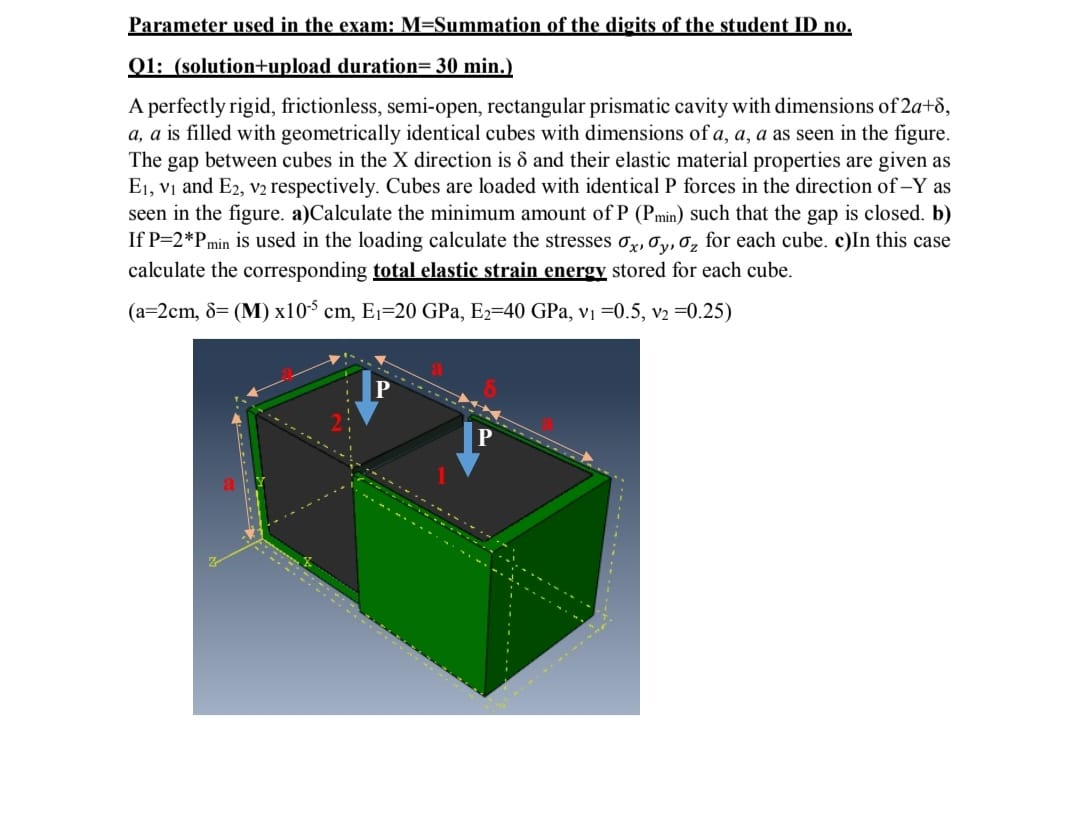
A perfectly rigid, frictionless, semi-open, rectangular prismatic cavity with dimensions of \( 2 a+\delta \), \( a, a \) is filled with geometrically identical cubes with dimensions of \( a, a, a \) as seen in the figure. The gap between cubes in the \( \mathrm{X} \) direction is \( \delta \) and their elastic material properties are given as \( E_{1}, v_{1} \) and \( E_{2}, v_{2} \) respectively. Cubes are loaded with identical \( P \) forces in the direction of \( -Y \) as seen in the figure. a)Calculate the minimum amount of \( \mathrm{P}\left(\mathrm{P}_{\min }\right) \) such that the gap is closed. b) If \( \mathrm{P}=2 * \mathrm{P}_{\min } \) is used in the loading calculate the stresses \( \sigma_{x}, \sigma_{y}, \sigma_{z} \) for each cube. c)In this case calculate the corresponding total elastic strain energy stored for each cube.
\( \left(\mathrm{a}=2 \mathrm{~cm}, \delta=(\mathbf{M}) \times 10^{-5} \mathrm{~cm}, \mathrm{E}_{1}=20 \mathrm{GPa}, \mathrm{E}_{2}=40 \mathrm{GPa}, v_{1}=0.5, v_{2}=0.25\right) \)