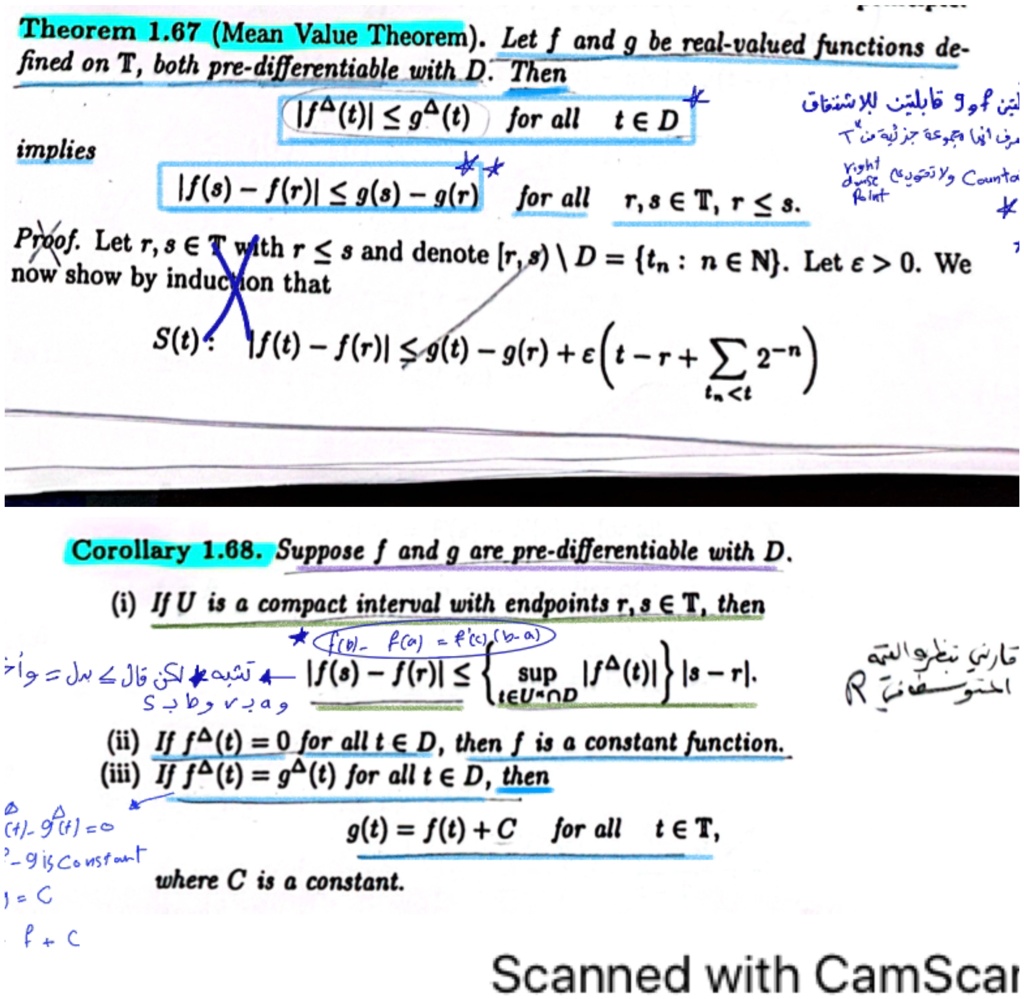
I want proof for (ii) and (iii) of the corollary.
The name of the book if it helps: [DYNAMIC EQUATION OF TIME SCALES].
Theorem 1.67 (Mean Value Theorem). Let f and g be real-valued functions defined on T, both pre-differentiable with D.~ Then |f(t)| ≤ g(t) for all t in D implies |f(r) - g(r)| ≤ |f(s) - g(s)| for all r, s in T, r ≤ s. Proof. Let r, s in T with r < s and denote [r, s)D = {tn : n in N}. Let ε > 0. We now show by induction that
S(t) ≤ |f(t) - f(r)| + |t - r| ≤ g(r + ε) - g(r) + ε(1 + D2 - n).
Corollary 1.68. Suppose f and g are pre-differentiable with D:
(i) If U is a compact interval with endpoints r, s in T, then |F(o) - P(a)| = f(c)(b - a) = ∫wJ5gSIkaaj4lf(o) - f(r)| ≤ sup |f(t) - s - b|, ∀t in EU - nD.
(ii) If f(t) = 0 for all t in D, then f is a constant function.
(iii) If f(t) = g(t) for all t in D, then
g = f + C for all t in T, where C is a constant. J = C P + C Scanned with CamSca.