2. NASA has asked you to develop a technique for the analysis of metals in the water supply in
a space shuttle or space station. Because the environment on a space station is closed, the
water needs to remain safe for human exposure with little treatment, and therefore you must
work in the pH range of 5.00-9.00.
a.
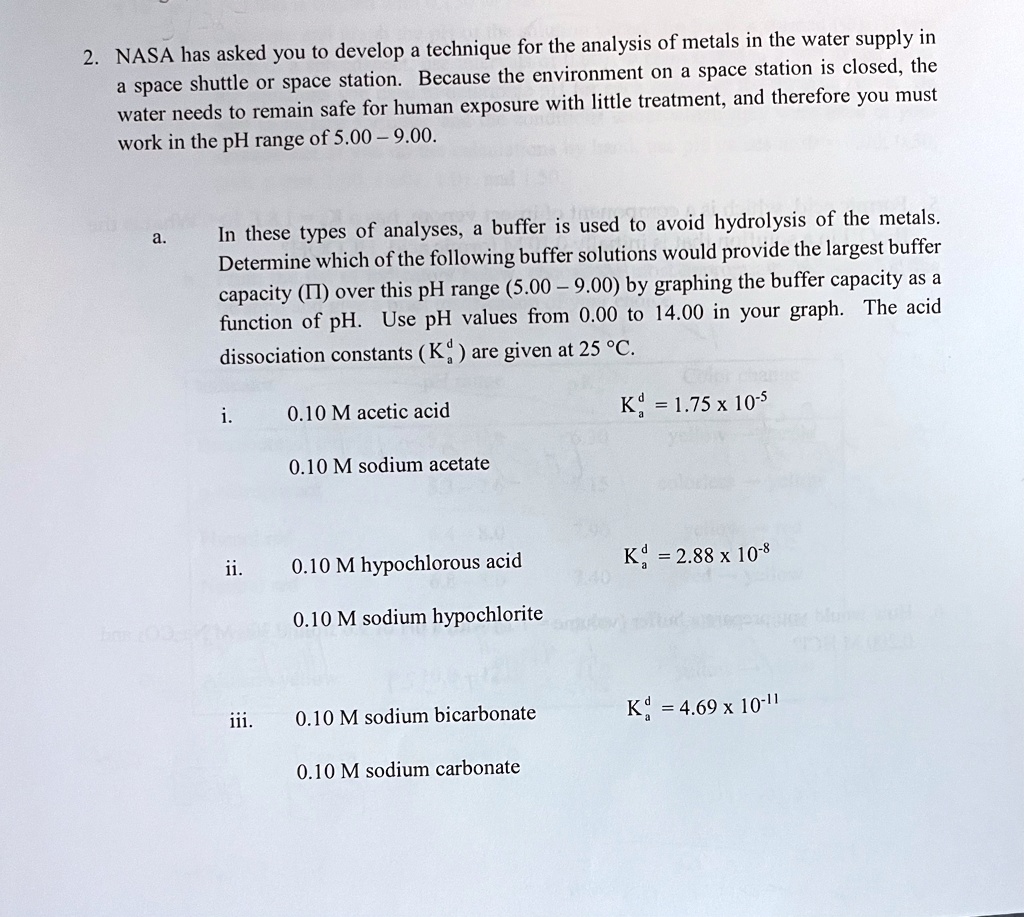
In these types of analyses, a buffer is used to avoid hydrolysis of the metals.
Determine which of the following buffer solutions would provide the largest buffer
capacity (Π) over this pH range (5.00-9.00) by graphing the buffer capacity as a
function of pH. Use pH values from 0.00 to 14.00 in your graph. The acid
dissociation constants (K) are given at 25 °C.
i.
0.10 M acetic acid
0.10 M sodium acetate
$$K_a = 1.75 \times 10^{-5}$$
ii.
0.10 M hypochlorous acid
$$K_a = 2.88 \times 10^{-8}$$
0.10 M sodium hypochlorite
iii.
0.10 M sodium bicarbonate
$$K_a = 4.69 \times 10^{-11}$$
0.10 M sodium carbonate