Ace - AI Tutor
Ask Our Educators
Textbooks
My Library
Flashcards
Scribe - AI Notes
Notes & Exams
Download App
nicholas harris

nicholas h.

Divider

Questions asked

BEST MATCH

When drug trials go horribly wrong..Please read the article from the NY Times, originally published in 2006When DrugTrials Go Horribly Wrong". The article describes an event that happened several years ago, nevertheless there are some important lessons to be learned from it.Was what transpired in the trial in compliance with the 3 principles of the Belmont report? Why or why not? Address each of the 3 principles that comprise the Belmont Report. (5 points per principle)What you would do differently if you could turn back the hands of time and restart this study? Explain what you would do differently, and why. (15 points)As a quick review, the Belmont Report principles are:Respect for persons - This principle speaks to the need for individuals to be

View Answer
divider
BEST MATCH

Julio buys 100 shares of stock selling for $90 per share, using a margin of 90%: if the stock pays annual dividends of $6 per share and a margin loan can be obtained at an annual interest cost of 6%, determine the return on invested capital the investor would realize if the price of stock increases to $110 within six months?

View Answer
divider
BEST MATCH

Which compound would be expected to show intense IR absorption at 2250 cm-1

View Answer
divider
BEST MATCH

Application of Double Integrals to Probability Theory The normal distribution plays a very important role in probability theory. The probability density function for a normally distributed random variable $X$ is defined by $$f(x) = \frac{1}{\sigma\sqrt{2\pi}}e^{-(x-\mu)^2/2\sigma^2}$$ where $\mu$ is the mean of $X$ and $\sigma$ is the standard deviation. When $\mu = 0$ and $\sigma = 1$ this is called the standard normal distribution. In this Mini-Project we will use double integrals to show that $f$ in fact defines a probability density function. That is, we will show that $$\int_{-\infty}^{\infty} \frac{1}{\sigma\sqrt{2\pi}}e^{-(x-\mu)^2/2\sigma^2} dx = 1$$ Setup We start by working with the function $g(x,y) = e^{-(x^2+y^2)}$. We will make use of the fact that we can define the improper integral $$\iint_{g^2} e^{-(x^2+y^2)} dA = \int_{-\infty}^{\infty}\int_{-\infty}^{\infty} e^{-(x^2+y^2)} dydx$$ in two ways. Namely, $$\iint_{g^2} e^{-(x^2+y^2)} dA = \lim_{a\to\infty} \iint_{D_a} e^{-(x^2+y^2)} dA$$ where $D_a$ is the disk with radius $a$ centered at the origin, and $$\iint_{g^2} e^{-(x^2+y^2)} dA = \lim_{a\to\infty} \iint_{S_a} e^{-(x^2+y^2)} dA$$ where $S_a$ is the square with vertices $(\pm a, \pm a)$. Problem. (20 points) (a) Use polar coordinates to show that $$\lim_{a\to\infty} \iint_{D_a} e^{-(x^2+y^2)} dA = \pi$$ (b) Show that $$\lim_{a\to\infty} \iint_{S_a} e^{-(x^2+y^2)} dA = \left[ \int_{-\infty}^{\infty} e^{-x^2} dx \right] \left[ \int_{-\infty}^{\infty} e^{-y^2} dy \right]$$ (c) Use parts (a) and (b) to conclude that $$\int_{-\infty}^{\infty} e^{-x^2} dx = \sqrt{\pi}$$ (d) Use part (c) and substitution to conclude that $$\int_{-\infty}^{\infty} \frac{1}{\sqrt{2\pi}}e^{-x^2/2} dx = 1$$ (* This shows that the standard normal distribution is a probability density function.) (e) (Bonus: 5 points) Let $\mu$ and $\sigma$ be constants. Show that $$\int_{-\infty}^{\infty} \frac{1}{\sigma\sqrt{2\pi}}e^{-(x-\mu)^2/2\sigma^2} dx = 1$$

View Answer
divider
BEST MATCH

Human papillomavirus (HPV) is a naked, dsDNA virus with an icosahedral capsid structure. Based on the virus structure, how would this virus most likely exit the host cell? Multiple Choice

View Answer
divider
BEST MATCH

Consider the problem: $\begin{cases} c\rho u_{tt} = (K_0 u_x)_x + \alpha u, & 0 < x < L, \\ u(0, t) = 0, \\ u(L, t) = 0, \\ u(x, 0) = f(x), \end{cases}$ where $c$, $\rho$, $K_0$, and $\alpha$ are functions of $x$. Assume that the appropriate eigenfunctions are known. (a) Show that the eigenvalues are positive if $\alpha < 0$. (b) Solve the problem.

View Answer
divider
BEST MATCH

First use the appropriate properties of logarithms to rewrite f(x), and then find f'(x). f(x) = 5x + \ln 5x Rewrite f(x) using properties of logarithms. f(x) = (Do not simplify.)

View Answer
divider
BEST MATCH

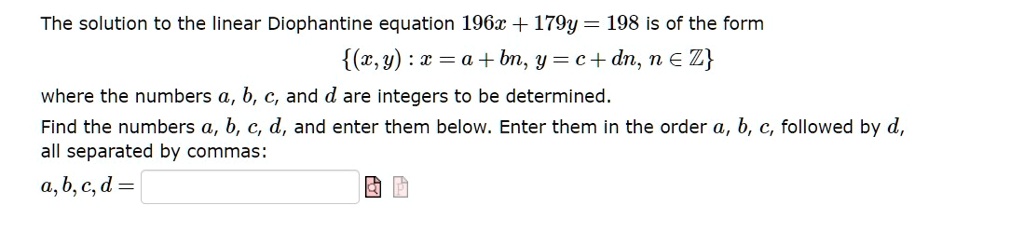
The solution to the linear Diophantine equation $196x + 179y = 198$ is of the form \\ $\{(x,y) : x = a + bn, y = c + dn, n \in \mathbb{Z}\}$ \\ where the numbers $a$, $b$, $c$, and $d$ are integers to be determined.\ Find the numbers $a$, $b$, $c$, $d$, and enter them below. Enter them in the order $a$, $b$, $c$, followed by $d$,\ all separated by commas:\ a, b, c, d =
View Answer
divider
BEST MATCH

4. Let G = (V, E) be a graph and c: E \rightarrow \mathbb{R}^+ be an edge cost function. We call an edge e \in E (1) necessary if e is contained in every minimum spanning tree; (2) useless if no minimum spanning tree contains e; (3) optional else. How many edges in the graph below are necessary? 1 4 2 2 2 2 6 4 5 3 2 3 5 4 7 2 1 4 2 2 3 2 Enter answer here 5. How many edges of the above graph are optional? Enter answer here

View Answer
divider
BEST MATCH

A train is initially traveling along a straight track at a speed of 100 km/h. For 6 s it is subjected to a constant deceleration of 0.5 m/s², and then for the next 3 s it has a constant deceleration $a_c$. Part A Determine $a_c$ so that the train stops at the end of the 9-s time period. Express your answer to three significant figures and include the appropriate units.

View Answer
divider