Ace - AI Tutor
Ask Our Educators
Textbooks
My Library
Flashcards
Scribe - AI Notes
Notes & Exams
Download App
nicholas lee

nicholas l.

Divider

Questions asked

BEST MATCH

Ordering 3 points Some signal transduction pathways lead to changes in gene expression. This means there is a change in the gene(s) that are transcribed into messenger RNA and then made into protein. Depending on which proteins are made, a cell might change its metabolism, growth, or behavior in some other way. Place the following items in the order in which they would occur for a signal that ultimately changes a cell's behavior by altering gene expression. first 1 ligand signal binds its receptor 2 a new, different protein (or set of proteins) is made 3 a signal transduction pathway changes messenger RNA transcription 4 the new protein(s) change the cell's behavior (example: metabolism, growth, etc.) last

View Answer
divider
BEST MATCH

All are part of the nonspecific immune response except: Amygdala Natural Killer Cells Macrophages Phagocytes

View Answer
divider
BEST MATCH

According to the reading, which of the following is an example of using someone as a mere means? Making a promise to someone with the intention of breaking it. Paying a taxi driver to take you to your next location. Having a bank teller cash a check for you. All of these.

View Answer
divider
BEST MATCH

What is the magnitude F of the average force exerted on the ball by the wall? Express your answer in terms of some or all of the variables m, vi, θi, Δt. View Available Hint(s)for Part B Activate to select the appropriates template from the following choices. Operate up and down arrow for selection and press enter to choose the input value typeActivate to select the appropriates symbol from the following choices. Operate up and down arrow for selection and press enter to choose the input value type F = nothing

View Answer
divider
BEST MATCH

How do we cite in APA and author with three What is Yoder versus university of Louisville ETAL number three 2009 CV 00205 about what is the summary of what happened in the summary of a conclusion of the story and what was the legal rights behind it what was the final decision on the case

View Answer
divider
BEST MATCH

The solution of the system $X' = \begin{pmatrix} 2 & -1 \ -1 & 2 \end{pmatrix} X$ is a. $X = c_1 \begin{pmatrix} 1 \ 1 \end{pmatrix} e^t + c_2 \begin{pmatrix} -1 \ 1 \end{pmatrix} e^{3t}$ b. $X = c_1 \begin{pmatrix} 1 \ 1 \end{pmatrix} e^{-t} + c_2 \begin{pmatrix} -1 \ 1 \end{pmatrix} e^{-3t}$ c. $X = c_1 \begin{pmatrix} -1 \ 1 \end{pmatrix} e^t + c_2 \begin{pmatrix} 1 \ 1 \end{pmatrix} e^{3t}$ d. none of the above e. $X = c_1 \begin{pmatrix} -1 \ 1 \end{pmatrix} e^{-t} + c_2 \begin{pmatrix} 1 \ 1 \end{pmatrix} e^{-3t}$

View Answer
divider
BEST MATCH

f) V-bracket F Strut Spring V-bracket X2 X3

View Answer
divider
BEST MATCH

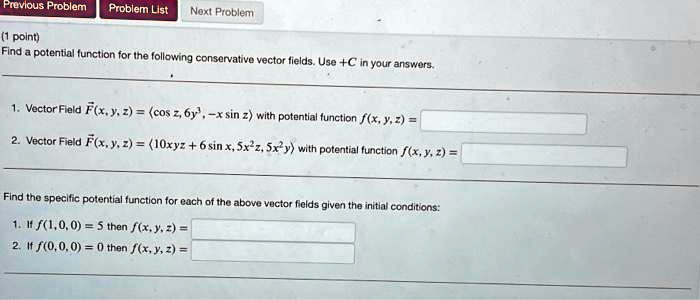
Previous Problem Problem List Next Problem (1 point) Find a potential function for the following conservative vector fields. Use +C in your answers. 1. Vector Field \(\vec{F}(x, y, z) = (\cos z, 6y^2, -x \sin z)\) with potential function \(f(x, y, z) =\) 2. Vector Field \(\vec{F}(x, y, z) = (10xyz + 6 \sin x, 5x^2z, 5x^2y)\) with potential function \(f(x, y, z) =\) Find the specific potential function for each of the above vector fields given the initial conditions: 1. If \(f(1, 0, 0) = 5\) then \(f(x, y, z) =\) 2. If \(f(0, 0, 0) = 0\) then \(f(x, y, z) =\)
View Answer
divider
BEST MATCH

Suppose that the cumulative distribution function of the discrete random variable X is given by $\begin{equation*} F(X) = \begin{cases} 0 & x \le 0\\ 0 & 0 < x < 1\\ \frac{1}{12} & 1 \le x < 2\\ \frac{11}{12} & 2 \le x < 3\\ 1 & x \ge 3 \end{cases} \end{equation*} $ Find P(X = 1), P(X = 2), P(X = 3).$

View Answer
divider
BEST MATCH

(1 point) Let V be a vector space, and T : V ? V a linear transformation such that ?(2$\vec{v_1}$ – 3$\vec{v_2}$) = ?2$\vec{v_1}$ + 3$\vec{v_2}$ and T(?3$\vec{v_1}$ + 5$\vec{v_2}$) = ?4$\vec{v_1}$ + 5$\vec{v_2}$ . Then ?($\vec{v_1}$) = ____$\vec{v_1}$ + ____$\vec{v_2}$, ?($\vec{v_2}$) = ____$\vec{v_1}$ + ____$\vec{v_2}$, ?(4$\vec{v_1}$ + 2$\vec{v_2}$) = ____$\vec{v_1}$ + ____$\vec{v_2}$.

View Answer
divider