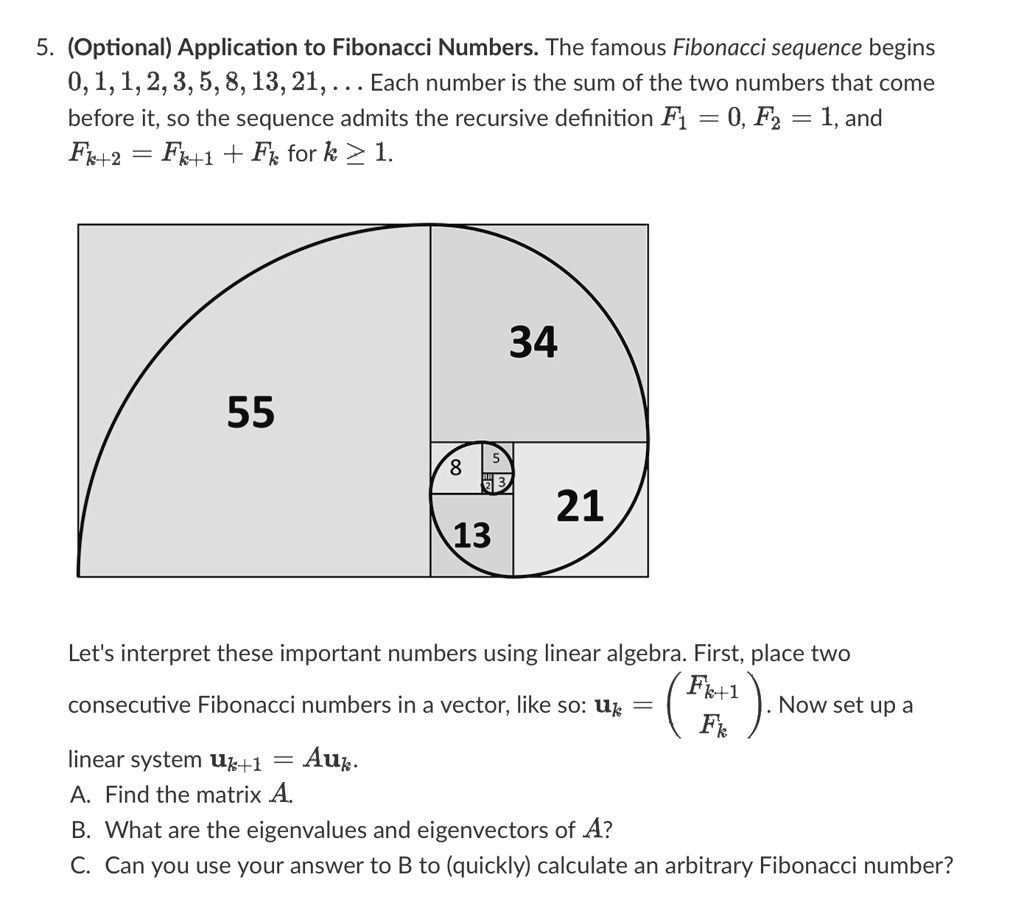
5. (Optional) Application to Fibonacci Numbers. The famous Fibonacci sequence begins
0, 1, 1, 2, 3, 5, 8, 13, 21,... Each number is the sum of the two numbers that come
before it, so the sequence admits the recursive definition $F_1 = 0$, $F_2 = 1$, and
$F_{k+2} = F_{k+1} + F_k$ for $k \ge 1$.
34
55
8
5
3
21
13
Let's interpret these important numbers using linear algebra. First, place two
consecutive Fibonacci numbers in a vector, like so: $u_k = \begin{pmatrix} F_{k+1} \\ F_k \end{pmatrix}$. Now set up a
linear system $u_{k+1} = Au_k$.
A. Find the matrix $A$.
B. What are the eigenvalues and eigenvectors of $A$?
C. Can you use your answer to B to (quickly) calculate an arbitrary Fibonacci number?