I need solving and whatever they ask, please answer it clearly and also explain each step by step of it. Kindly, writing should be clear so I can understand.
Problem 1:
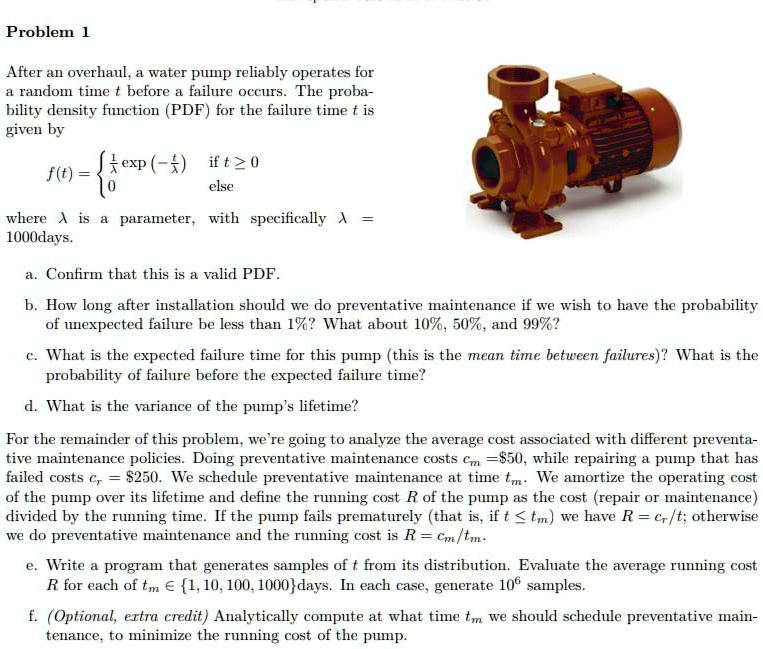
After an overhaul, a water pump reliably operates for a random time t before a failure occurs. The probability density function (PDF) for the failure time t is given by:
f(t) = e^(-λt) if t ≥ 0, else 0
where λ is a parameter, with specifically λ = 1/1000 days.
a. Confirm that this is a valid PDF.
b. How long after installation should we do preventative maintenance if we wish to have the probability of unexpected failure be less than 1%? What about 10%, 50%, and 99%?
c. What is the expected failure time for this pump (this is the mean time between failures)? What is the probability of failure before the expected failure time?
d. What is the variance of the pump's lifetime?
For the remainder of this problem, we're going to analyze the average cost associated with different preventative maintenance policies. Doing preventative maintenance costs Cm = -$50, while repairing a pump that has failed costs Cr = $250. We schedule preventative maintenance at time tm. We amortize the operating cost of the pump over its lifetime and define the running cost R of the pump as the cost (repair or maintenance) divided by the running time. If the pump fails prematurely (that is, if t < tm), we have R = Cr/t; otherwise, we do preventative maintenance and the running cost is R = Cm/tm.
e. Write a program that generates samples of t from its distribution. Evaluate the average running cost R for each of tm {1, 10, 100, 1000} days. In each case, generate 10 samples.
f. (Optional, extra credit) Analytically compute at what time tm we should schedule preventative maintenance to minimize the running cost of the pump.