Ace - AI Tutor
Ask Our Educators
Textbooks
My Library
Flashcards
Scribe - AI Notes
Notes & Exams
Download App
nicholas rose

nicholas r.

Divider

Questions asked

BEST MATCH

Conduct the hypothesis test: H0: μ = 10 versus Ha: μ ≠ 10, where μ is the population mean. The test is based on a sample of 40 observations, α=0.05. The rejection point conditions for this two-sided test are: Question 12Answer a. t>1.685 and t<-1.685 b. t>1.684 and t<-1.684 c. t>2.021 and t<-2.021 d. t>2.023 and t<-2.023 e. None of the answers

View Answer
divider
BEST MATCH

Which policymaking institution determines the money supply, sets the rules for how checks are cleared and how banks obtain new currency, and determines what activities banks may or may not engage in? Group of answer choices Treasury Department. Commerce Department. Securities and Exchange Commission. Federal Reserve System.

View Answer
divider
BEST MATCH

(a) $\theta_2(t)$ $T(t)$ $\theta_1(t)$ $k_2$ $k_1$ $J_2$ $J_1$ $B_1$ XXXXXXX $B_2$ XXXXXXX Figure Q1(a) A rotational mechanical system is shown in Figure Q1(a). $T(t)$ is the external torque and is the input to the system. Derive the differential equations and draw its block diagram, if $q_2(t)$ is the output of the system.

View Answer
divider
BEST MATCH

Which is the major product of the following reaction? Select one: a. $CH_2OH$ b. $COH$ c. $CH$ d. $CH_2OH$

View Answer
divider
BEST MATCH

Problem Given the nonlinear, unsteady, viscous 1-D Burgers equation: $\frac{\partial u}{\partial t} + u \frac{\partial u}{\partial x} = \nu \frac{\partial^2 u}{\partial x^2}$ Solve the nondimensionalized form of this equation numerically to obtain the nondimensional velocity distribution at different time steps in a domain extends between $x^* = -9$ to $x^* = 9$. The analytical solution of the Burgers equation is given by: $u^* = \frac{2 \sinh x^*}{\cosh x^* - e^{-t^*}}$ Use the analytical solution at nondimensional time of 0.1 as the boundary and initial conditions. Instructions to solve: 1- State the boundary and initial conditions 2- Use the 4<sup>th</sup> order modified Runge-Kutta scheme, explicit MacCormack scheme and implicit BTCS scheme. 3- Validate your results against the analytical solution and calculate the error at some selected time steps. 4- Interpret the accuracy of each method.

View Answer
divider
BEST MATCH

Assume impulse response and input to a system are given with the following equations: x[n] = u[n] - u[n-10] x[n] = (0.9)$^{n}$ u[n] a) Calculate and plot y[n] = x[n] * h[n] using Matlab b) Compare your answer in part (a) with paper and pencil method.

View Answer
divider
BEST MATCH

Find the Fourier coefficients for f(x) if -1 < x < 0 and if 0 < x < 1.

View Answer
divider
BEST MATCH

1) (45 points) Solve the following system of equations 5$x_1$ - 6$x_2$ + $x_3$ = -4 -2$x_1$ + 7$x_2$ + 3$x_3$ = 21 3$x_1$ - 12$x_2$ - 2$x_3$ = -27 with b) Gauss elimination with partial pivoting, d) LU decomposition without pivoting. e) Determine the coefficient matrix inverse using LU decomposition in (d). Check your results by verifying that [A][A]$^{-1}$ = [I]

View Answer
divider
BEST MATCH

A stock just paid a dividend of $5.00. The dividend is expacted to grow at a rate of 20% for a period of three years and then settle down to a long run stable growth rate of 5%. If the market requires a rate of return of 15% to hold assets of this risk, what price should the stock trade at? Select one: ? a. $59.64 ? b. 566.24 ? c. $69.81 ? d. $75.98 ? e. None of the above are correct solutions

View Answer
divider
BEST MATCH

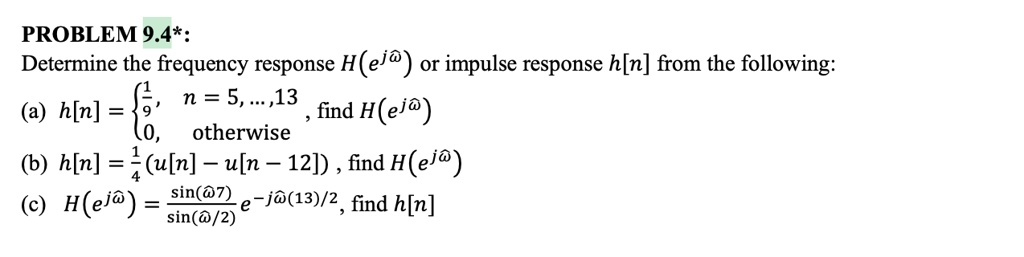
PROBLEM 9.4*: Determine the frequency response $H(e^{j\omega})$ or impulse response $h[n]$ from the following: (a) $h[n] = \begin{cases} \frac{1}{9}, & n = 5,...,13 \\ 0, & \text{otherwise} \end{cases}$, find $H(e^{j\omega})$ (b) $h[n] = \frac{1}{4}(u[n] - u[n - 12])$, find $H(e^{j\omega})$ (c) $H(e^{j\omega}) = \frac{\sin(7\omega)}{\sin(\omega/2)}e^{-j\omega(13)/2}$, find $h[n]$
View Answer
divider