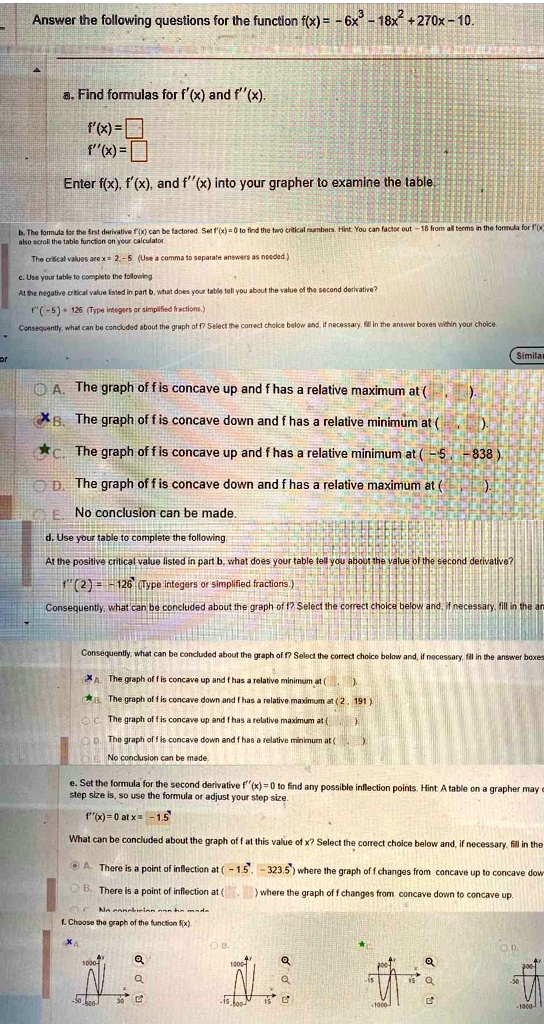
Hello, could you answer questions a-f in respect to the function f(x)=-6x^(3)-18x^(2)+270x-10? The answer choices are from a similar question. Please disregard those answers. Please also draw a new graph for f.
Answer the following questions for the function f(x)=-6x^(3)-18x^(2)+270x-10:
a. Find formulas for f'(x) and f''(x).
f'(x)=
f''(x)=
Enter f(x), f'(x), and f''(x) into your grapher to examine the table.
b. The formula for the first derivative f'(x) can be factored. Set f'(x)=0 to find the two critical numbers. Hint: You can factor out -18 from all terms in the formula for f'(x).
The critical values are x=2, -5 (Use a comma to separate answers as needed.)
c. Use your table to complete the following:
At the negative critical value listed in part b, what does your table tell you about the value of the second derivative?
f''(-5)=126 (Type integers or simplified fractions)
Consequently, what can be concluded about the graph of f? Select the correct choice below and, if necessary, fill in the answer boxes within your choice:
A. The graph of f is concave up and f has a relative maximum at (, ).
B. The graph of f is concave down and f has a relative minimum at ( ).
C. The graph of f is concave up and f has a relative minimum at ( ).
D. The graph of f is concave down and f has a relative maximum at (-, 2).
E. No conclusion can be made.
d. Use your table to complete the following:
At the positive critical value listed in part b, what does your table tell you about the value of the second derivative?
f''(2)=-126 (Type integers or simplified fractions)
Consequently, what can be concluded about the graph of f? Select the correct choice below and, if necessary, fill in the answer box:
A. The graph of f is concave up and f has a relative minimum at ( ).
B. The graph of f is concave down and f has a relative maximum at (2, 191).
C. The graph of f is concave up and f has a relative maximum at ( ).
D. The graph of f is concave down and f has a relative minimum at ( ).
No conclusion can be made.
e. Set the formula for the second derivative f''(x)=0 to find any possible inflection points. Hint: A table on a grapher may step size is, so use the formula or adjust your step size.
f''(x)=0 at x=-1.5
What can be concluded about the graph of f at this value of x? Select the correct choice below and, if necessary, fill in the:
A. There is a point of inflection at ( ) where the graph of f changes from concave up to concave down.
B. There is a point of inflection at ( ) where the graph of f changes from concave down to concave up.
f. Choose the graph of the function f(x).