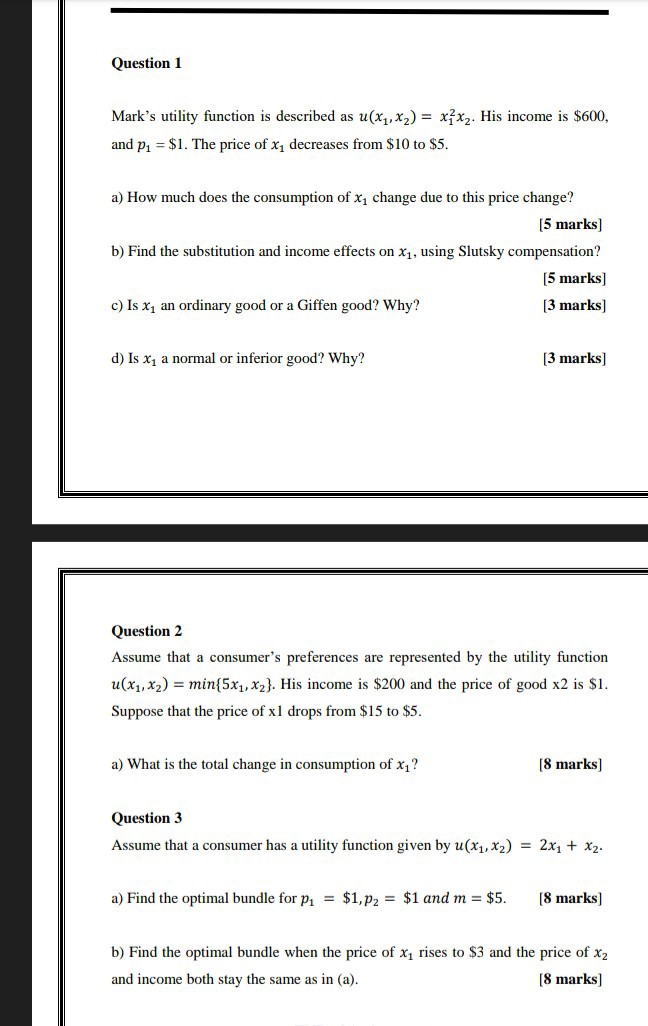
Question 1
Mark's utility function is described as \( u\left(x_{1}, x_{2}\right)=x_{1}^{2} x_{2} \). His income is \( \$ 600 \), and \( p_{1}=\$ 1 \). The price of \( x_{1} \) decreases from \( \$ 10 \) to \( \$ 5 \).
a) How much does the consumption of \( x_{1} \) change due to this price change?
[5 marks]
b) Find the substitution and income effects on \( x_{1} \), using Slutsky compensation?
[5 marks]
c) Is \( x_{1} \) an ordinary good or a Giffen good? Why?
[3 marks]
d) Is \( x_{1} \) a normal or inferior good? Why?
[3 marks]
Question 2
Assume that a consumer's preferences are represented by the utility function \( u\left(x_{1}, x_{2}\right)=\min \left\{5 x_{1}, x_{2}\right\} \). His income is \( \$ 200 \) and the price of good x 2 is \( \$ 1 \). Suppose that the price of \( x 1 \) drops from \( \$ 15 \) to \( \$ 5 \).
a) What is the total change in consumption of \( x_{1} \) ?
[8 marks]
Question 3
Assume that a consumer has a utility function given by \( u\left(x_{1}, x_{2}\right)=2 x_{1}+x_{2} \).
a) Find the optimal bundle for \( p_{1}=\$ 1, p_{2}=\$ 1 \) and \( m=\$ 5 \).
[8 marks]
b) Find the optimal bundle when the price of \( x_{1} \) rises to \( \$ 3 \) and the price of \( x_{2} \) and income both stay the same as in (a).
[8 marks]