Ace - AI Tutor
Ask Our Educators
Textbooks
My Library
Flashcards
Scribe - AI Notes
Notes & Exams
Download App
nicholas wilson

nicholas w.

Divider

Questions asked

BEST MATCH

Question 3 Which quantity of the ideal gas can be determined solely by knowing its cubic expansion coefficient $\alpha$? $\alpha = \frac{1}{V} \left(\frac{\partial V}{\partial T}\right)_P$ Temperature Pressure Volume 4 pts

View Answer
divider
BEST MATCH

The nurse has to administer amoxicillin to the pediatric patient who weighs 40 lbs. The dose required is 60 mg/kg/day BID. Calculate the mg/dose the patient will receive

View Answer
divider
BEST MATCH

The Berlin Blockade was a. a temporary defensive measure by the United States that was soon taken down. b. a means for the United States to justify its threat to mobilize Allied forces stationed in Turkey. c. the Soviet Union's reaction to the establishment of a separate currency in the western occupied zones. d. erected because the United States threatened to invade the Soviet Union. e. a barrier erected by Allied forces in postwar Berlin to shield them from angry protests of starving residents.

View Answer
divider
BEST MATCH

When determining where to work or which job to take, the wage that should be considered is the: Multiple choice question. real wage. nominal wage. expected wage. marginal wage.

View Answer
divider
BEST MATCH

The inside of a furnace wall is at 1000°C and with the existing wall of material with thermal conductivity of 1.7 W/mK looses 2.5 kW/m² when the outside is exposed to convection to air at 30°C with h = 27 W/m²K. Determine the wall thickness. Additionally 75 mm thickness of insulation with k = 0.15 W/mK is added on the inside. The furnace wall temperature and the surrounding temperature and convection coefficient remain unchanged. Determine the reduction in heat flow and reduction in the outside surface temperature. Also find the overall heat transfer coefficient and the temperature gradient in each layer. Case 1: Fig. P. 2.1(a) k = 1.7 W/mK 1000°C h = 27 W/m²K 1000°C 30°C Q = 2500 W/m² T2 30°C L k? = 0.15 W/mK k? = 1.7 W/mK 2 h = 27 W/m²K 30°C Q T3 T2 1 2 30°C 075 m 0.597 m Fig. P. 2.1. Problem model.

View Answer
divider
BEST MATCH

Interpolate the following data set with Newton interpolation ( P3(x) = b_0 + b_1(x - x_1) + b_2(x - x_1)(x - x_2) + b_3(x - x_1)(x - x_2)(x - x_3)) x \ 1.0 \ 2.0 \ 3.0 \ 4.0 y \ -0.4 \ -8.6 \ -8.4 \ 48.8 The coefficient b_0 is Answer:

View Answer
divider
BEST MATCH

2) I shuffle a deck and draw a hand of 5. What are the chances that I get at least one of each suit? 3) What are the chances of getting exactly one of each suit in a hand of 4?

View Answer
divider
BEST MATCH

- Or vehicles involved. - Remove the airbag and decontaminate the patient. - Disconnect the battery in low light. - Inspect the airbag and check underneath for damage. - Much

View Answer
divider
BEST MATCH

Evaluate the line integral ∫ 3𝑥^2 − 2𝑦 𝑑𝑠 𝐶 where C is the line segment from point (3,6) to the point (1,-1). Show all work.

View Answer
divider
BEST MATCH

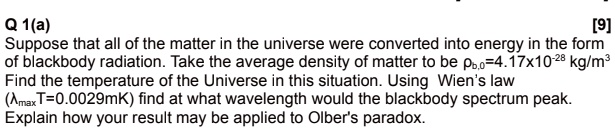
Q 1(a) Suppose that all of the matter in the universe were converted into energy in the form of blackbody radiation. Take the average density of matter to be $\rho_{b,0} = 4.17 \times 10^{-28} kg/m^3$ Find the temperature of the Universe in this situation. Using Wien's law ($\lambda_{max} T = 0.0029 mK$) find at what wavelength would the blackbody spectrum peak. Explain how your result may be applied to Olber's paradox.
View Answer
divider