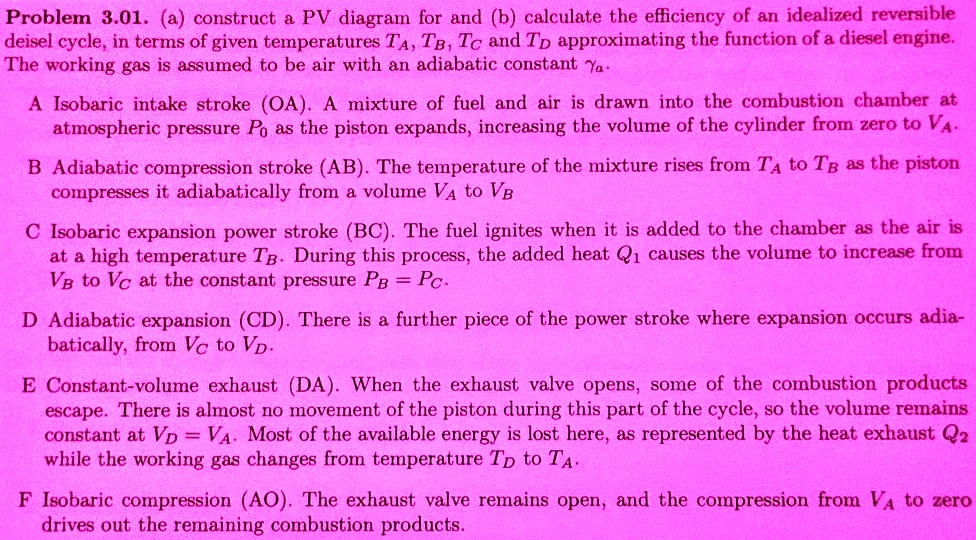
Problem 3.01. (a) Construct a PV diagram for and (b) calculate the efficiency of an idealized reversible diesel cycle, in terms of given temperatures T_(A), T_(B), T_(C), and T_(D) approximating the function of a diesel engine. The working gas is assumed to be air with an adiabatic constant γ_(a).
A Isobaric intake stroke (OA). A mixture of fuel and air is drawn into the combustion chamber at atmospheric pressure P_(0) as the piston expands, increasing the volume of the cylinder from zero to V_(A).
B Adiabatic compression stroke (AB). The temperature of the mixture rises from T_(A) to T_(B) as the piston compresses it adiabatically from a volume V_(A) to V_(B).
C Isobaric expansion power stroke (BC). The fuel ignites when it is added to the chamber as the air is at a high temperature T_(B). During this process, the added heat Q_(1) causes the volume to increase from V_(B) to V_(C) at the constant pressure P_(B) = P_(C).
D Adiabatic expansion (CD). There is a further piece of the power stroke where expansion occurs adiabatically, from V_(C) to V_(D).
E Constant-volume exhaust (DA). When the exhaust valve opens, some of the combustion products escape. There is almost no movement of the piston during this part of the cycle, so the volume remains constant at V_(D) = V_(A). Most of the available energy is lost here, as represented by the heat exhaust Q_(2) while the working gas changes from temperature T_(D) to T_(A).
F Isobaric compression (AO). The exhaust valve remains open, and the compression from V_(A) to zero drives out the remaining combustion products.