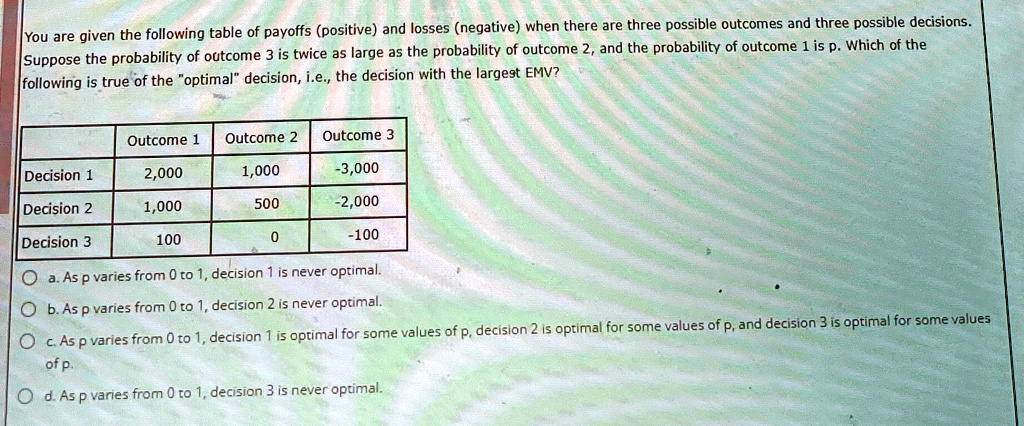
You are given the following table of payoffs (positive) and losses (negative) when there are three possible outcomes and three possible decisions.
Suppose the probability of outcome 3 is twice as large as the probability of outcome 2, and the probability of outcome 1 is p. Which of the
following is true of the \"optimal\" decision, i.e., the decision with the largest EMV?
Outcome 1 Outcome 2 Outcome 3
Decision 1
2,000
1,000
-3,000
Decision 2
1,000
500
-2,000
Decision 3
100
0
-100
a. As p varies from 0 to 1, decision 1 is never optimal.
b. As p varies from 0 to 1, decision 2 is never optimal.
c. As p varies from 0 to 1, decision 1 is optimal for some values of p, decision 2 is optimal for some values of p, and decision 3 is optimal for some values
of p.
d. As p varies from 0 to 1, decision 3 is never optimal.